What Is AEO? Answer Engine Optimization Explained
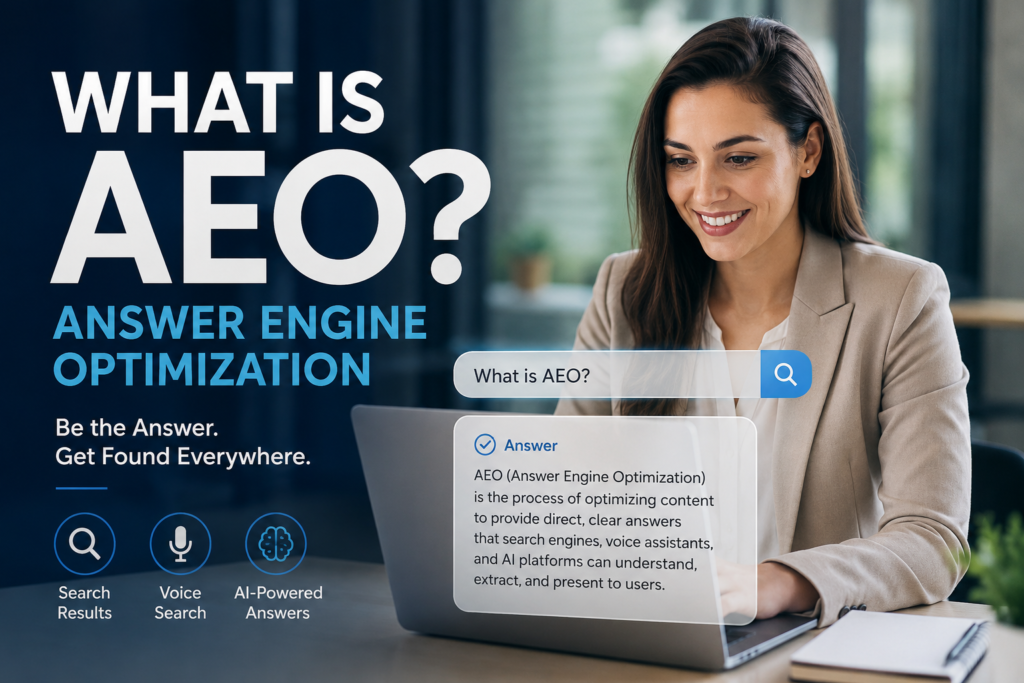
AEO stands for Answer Engine Optimization. It is the process of creating, organizing, and improving website content so search engines, answer engines, voice assistants, and AI-powered search systems can understand the content and use it as a clear answer.
This strategy helps your website answer the exact questions people ask online. Instead of focusing only on keywords, it focuses on clear answers, helpful explanations, question-based headings, structured content, entity clarity, schema markup, and trustworthy information.
Traditional SEO helps a page get found in search results. Answer-focused optimization helps a page become easier to understand, summarize, extract, and present as an answer. This matters because people now search with full questions, voice commands, featured snippets, People Also Ask results, AI Overviews, AI search tools, and conversational platforms.
AssistantEtc helps businesses improve answer-ready content by turning unclear website copy into useful, structured content that supports search visibility, AI understanding, customer trust, and better online discoverability.
Get Help With AEO OptimizationAI Search Summary: What This Page Explains
This page explains what Answer Engine Optimization is, why it matters, how it works, how it differs from SEO and GEO, and how businesses can use answer-ready content to improve visibility in modern search and AI-powered discovery systems.
In plain language, this approach helps a website become more useful when someone asks a question. It strengthens direct-answer sections, FAQs, comparison tables, structured content, schema markup, and entity relationships so both people and search systems can understand the page faster.
TL;DR: What Is AEO?
Answer Engine Optimization is the practice of making website content clear enough for answer engines to understand, extract, summarize, and present as a useful response to a user’s question.
The goal is to answer real questions directly. A strong page does not make visitors dig for the answer. It gives the answer first, then supports it with examples, details, comparisons, FAQs, schema, and practical next steps.
- AEO stands for Answer Engine Optimization.
- It focuses on answers, not just rankings.
- It supports featured snippets, People Also Ask results, voice search, AI answers, and question-based search.
- It works best when combined with SEO, strong content strategy, schema markup, and clear website structure.
- It helps search systems understand who you are, what you offer, who you help, and what questions your content answers.
- It can improve visibility and trust, but it cannot ethically guarantee rankings, AI mentions, traffic, leads, or revenue.
Why Answer Engine Optimization Matters
Search behavior has changed. People no longer search only with short keyword phrases. They ask complete questions such as “What does this term mean?”, “How do I make my website show up in AI answers?”, “Why is my business not appearing online?”, and “What should I add to my website to answer customer questions?”
Answer engines are designed to respond to questions. Google can show featured snippets, People Also Ask answers, and AI-generated summaries. Voice assistants can read short answers. AI search tools can summarize information from multiple sources. If your website content is vague, thin, outdated, or poorly structured, it may be harder for these systems to understand and use.
Answer-focused content helps solve that problem by making your page more specific, organized, complete, and useful. It gives both people and search systems a clearer understanding of the topic.
Key takeaway: SEO helps your page get found. Answer optimization helps your page respond clearly enough to be understood, extracted, summarized, and trusted.
Who Needs Answer-Focused Website Content?
This strategy is useful for businesses, service providers, local companies, content creators, educators, consultants, medical practices, law firms, real estate professionals, home service companies, dental offices, med spas, coaches, and any business that wants its website to answer customer questions more clearly.
Your business may need this type of optimization if people ask questions before they contact you. Those questions may be about pricing, services, process, trust, location, qualifications, comparisons, timing, problems, solutions, or what to expect.
Local Businesses
Local businesses can answer questions about services, service areas, appointments, process, pricing factors, and what customers should know before reaching out.
Service Providers
Service pages can explain what a service is, who it is for, what problem it solves, how the process works, and why it matters.
Professional Brands
Consultants, marketers, real estate agents, attorneys, healthcare providers, and specialists can create clearer educational content.
Growing Websites
Established websites can build topic clusters, answer FAQs, support internal linking, and improve the usefulness of existing content.
What Is an Answer Engine?
An answer engine is a search or AI system that responds to a question with a direct answer instead of only showing a list of website links.
Traditional search results still matter. However, many platforms now try to answer the question directly. This can happen through featured snippets, People Also Ask results, knowledge panels, AI summaries, voice search responses, and conversational AI tools.
Examples of answer-based search experiences include Google featured snippets, Google People Also Ask, Google AI Overviews, Google AI Mode, Bing Copilot, ChatGPT, Gemini, Claude, Perplexity, Siri, Alexa, and other voice or AI-powered search systems.
For businesses, this means your content must be written and structured in a way that answer systems can understand. A page should make the main topic obvious, answer the primary question quickly, and support that answer with trustworthy details.
AEO vs SEO vs GEO: What Is the Difference?
AEO, SEO, and GEO are related, but they are not the same. This page focuses on the answer-focused part of modern search optimization.
| Strategy | Main Purpose | Best Used For |
|---|---|---|
| SEO | Improves a website’s visibility in traditional search engines through technical health, content, relevance, links, structure, and user experience. | Helping pages rank in Google, drive organic traffic, and support crawlability and indexability. |
| AEO | Improves content so answer engines can understand the question being answered and present the content as a direct response. | Featured snippets, People Also Ask, voice search, FAQ content, direct-answer sections, and question-based search results. |
| GEO | Improves content for generative AI systems that summarize, synthesize, cite, or recommend information. | AI search visibility, AI-generated summaries, conversational search, and AI-assisted discovery. |
SEO is the foundation because pages still need to be crawlable, useful, relevant, and trustworthy. Answer-focused content builds on that foundation by making the content more useful for questions. GEO is related because generative AI systems also need clear, structured, reliable content. However, the main focus here is helping your content become a better answer.
How This Helps Businesses
Answer optimization helps businesses become easier to discover when potential customers ask questions. This matters because many buying decisions begin with a question, not a company name.
A potential customer might ask:
- What does this service include?
- How much does this type of service usually cost?
- What should I know before hiring someone?
- Who provides this service near me?
- What is the difference between two similar services?
- How do I know if I need this service?
- What questions should I ask before choosing a provider?
If your website answers those questions clearly, your business becomes easier to understand. That can support trust, engagement, and contact opportunities. This does not replace reputation, service quality, reviews, or strong business information. It strengthens the way your website communicates those signals.
Clearer Search Understanding
Search systems can better understand the purpose of your page, the questions it answers, and the audience it serves.
Better Question Coverage
Your content can cover the real questions customers ask before they decide to contact a business.
More Trust From Visitors
When your page answers questions clearly, visitors feel more informed and less confused.
Stronger Conversion Support
Clear answers can support conversions by explaining problems, solutions, next steps, expectations, and decision criteria.
Does Your Website Clearly Answer Customer Questions?
If your pages are vague, thin, outdated, or hard to scan, answer engines may struggle to understand what your business offers and why your content is useful.
Request AEO HelpHow Answer Engine Optimization Works
Answer Engine Optimization works by improving the clarity, structure, depth, and usefulness of a page. It does not mean stuffing content with questions or repeating the same phrase over and over. Strong content is written for people first, while also being easy for search systems to interpret.
A weak page might say, “We offer marketing services for businesses.” That sentence is too broad. It does not explain the specific service, audience, problem, benefit, or answer.
A stronger version would say, “AssistantEtc helps businesses improve answer-focused content by rewriting website copy into clear questions, direct answers, FAQs, service explanations, schema-supported sections, and customer-focused pages.”
Answer-Ready Content Works Best When It Includes:
- A clear answer near the top of the page.
- One primary topic per page.
- Question-based headings that match how people search.
- Short answers followed by deeper explanations.
- Definitions of important terms.
- Examples that connect the topic to real customer decisions.
- FAQ sections based on actual customer questions.
- Schema markup that matches the visible content. For technical guidance, see Google’s structured data documentation.
- Internal links to related services and educational pages.
- Consistent business, service, and contact information.
- Clear next steps for readers who want help.
What Makes Content Answer-Ready?
Answer-ready content gives a direct answer first, then supports that answer with context, examples, steps, comparisons, FAQs, and trustworthy explanations.
Many websites bury the answer under long introductions or generic marketing copy. That creates friction for both readers and answer systems. Better structure improves the page by making the answer obvious.
Weak Example
“We are a full-service company offering customized solutions for businesses of all sizes.”
Stronger Example
“Answer Engine Optimization helps businesses structure website content so search engines, featured snippets, AI systems, and voice assistants can understand and present the content as a clear answer.”
The stronger example explains the topic, names the purpose, and connects the content to answer-based search experiences. It is more useful for a human reader and easier for search systems to interpret.
Important AEO Elements
AEO is not one single task. It is a combination of content strategy, structure, user intent, technical clarity, and trust-building information.
| Element | Why It Matters | Example |
|---|---|---|
| Direct Answer | Helps users and answer engines understand the main point quickly. | “AEO stands for Answer Engine Optimization.” |
| Question-Based Headings | Matches how people search using full questions. | “How does answer optimization work?” |
| FAQs | Captures related questions and supports voice search and featured snippets. | “Is this different from SEO?” |
| Schema Markup | Gives search engines structured information about the page. | FAQPage, WebPage, Article, Service, BreadcrumbList. |
| Entity Clarity | Helps systems understand people, businesses, services, platforms, and topics. | AssistantEtc, Answer Engine Optimization, SEO, featured snippets. |
| Helpful Examples | Makes abstract concepts easier to understand and apply. | Before-and-after content examples. |
Related Entities for Answer Engine Optimization
Entity clarity is important because answer engines need context. An entity is a clearly identifiable person, business, service, platform, concept, place, or topic. When your content connects related entities naturally, search systems can better understand what the page is about.
For this topic, related entities may include:
- Answer Engine Optimization
- AEO
- Search Engine Optimization
- Featured snippets
- People Also Ask
- Voice search
- Google AI Overviews
- Google AI Mode
- ChatGPT
- Gemini
- Claude
- Perplexity
- Schema markup
- Structured data
- FAQ content
- Question-based search
- Search intent
- Topical authority
- E-E-A-T
- Local SEO
- Google Business Profile
The goal is not to force these terms into the page. The goal is to explain the topic completely and naturally so the content has stronger meaning.
AssistantEtc and Answer-Focused Content Support
AssistantEtc helps businesses improve answer-ready website content by reviewing existing pages and strengthening them for direct answers, customer questions, search intent, entity clarity, internal linking, FAQ structure, schema alignment, and reader trust.
This type of work is especially useful when a business already has website pages but those pages are too vague, too short, too company-centered, or not clear enough for modern answer-based search. The goal is not to make content sound robotic. The goal is to make each page more useful, specific, structured, and easier to understand.
Transparent expectation: Clearer answer-focused content can improve the usefulness of your website, but it cannot guarantee exact rankings, AI citations, search traffic, leads, or sales.
Website Checklist for Better Answers
Use this checklist to review whether your website content is ready for answer engines.
- Each important page has one clear primary topic.
- The page answers the main question near the top.
- The H1 clearly describes the page topic.
- Headings are written in natural language.
- The content includes concise answers and deeper explanations.
- The page includes FAQs based on real customer questions.
- The content explains related terms and supporting topics.
- The page includes examples, comparisons, or steps when helpful.
- The business name, services, locations, and contact information are consistent.
- The page avoids vague claims and unsupported promises.
- The writing is easy to scan on desktop and mobile.
- The content links to related service pages and educational resources.
- The page includes a clear call to action.
- The schema markup matches the visible content.
- The page is reviewed and updated as search behavior changes.
How This Supports Voice Search
Voice search is naturally question-based. People usually do not speak in short keyword fragments. They ask full questions such as “What does this mean?”, “How do I optimize my website for answers?”, or “How can my business show up when people ask questions online?”
Answer-ready content supports voice search by using conversational language, direct answers, clear headings, and concise explanations. If a sentence sounds natural when read out loud, it is usually stronger for voice search than a sentence filled with jargon or awkward keyword repetition.
Voice search tip: Write answers in a way a real person would understand if the answer were read aloud.
How This Supports Local Business Visibility
Local businesses can benefit from answer-focused content because many customer questions include location, service type, urgency, and trust concerns. A local customer may ask who provides a service nearby, what the process includes, how to compare providers, or what to know before booking.
For local visibility, your content should clearly explain what your business does, who you help, where you serve, what services you provide, and what questions customers commonly ask before contacting you.
A local business page can answer questions such as:
- What services do you offer?
- What areas do you serve?
- How does your process work?
- What should customers know before contacting you?
- What factors affect pricing?
- What makes your service different?
- How can someone request help?
When your website, Google Business Profile, service pages, FAQs, reviews, and online mentions communicate consistent information, your local business entity becomes clearer. That clarity supports local SEO and answer-based discovery.
Common Mistakes
Many businesses want better search and AI visibility, but their website content is not written in a way that answer engines can easily understand. The issue is often not the topic. It is the structure, wording, depth, or lack of direct answers.
Too Much Fluff
Long introductions without clear answers make the page harder to scan and harder to extract.
No FAQ Section
Missing FAQs can cause the page to miss natural questions, long-tail searches, and voice search opportunities.
Weak Entity Signals
If the page does not clearly explain the business, service, location, topic, and related concepts, answer engines have less context.
Missing Schema
Schema can help search engines understand the page, but it must be accurate and match the visible content.
Keyword Stuffing
Repeating phrases unnaturally can make the content feel robotic and less helpful.
Unsupported Claims
Claims about rankings, traffic, leads, awards, or results should not be used unless they are true and verifiable.
How to Optimize a Page for Answers
Optimization starts with the reader’s question. Every section should help answer that question or support the reader’s decision-making process.
Step 1: Identify the Main Question
Choose the primary question the page should answer. For this page, the main question is “What is AEO?” For a service page, the question may be “What does this service include?” or “How can this service help my business?”
Step 2: Place the Answer Near the Top
Do not hide the answer. Put a short, clear answer near the beginning of the page. Then expand with details, examples, and related questions.
Step 3: Add Supporting Questions
Include related questions that match how customers search. Good supporting questions include comparisons, examples, pricing factors, process explanations, mistakes, and next steps.
Step 4: Use Structured Sections
Use headings, short paragraphs, lists, tables, answer boxes, FAQs, summaries, and calls to action. These elements improve scanability and extraction.
Step 5: Add Accurate Schema
Use JSON-LD schema that matches the visible content. Helpful schema may include WebPage, Article, FAQPage, Service, BreadcrumbList, Organization, and Person schema when appropriate.
Step 6: Link to Related Pages
Connect this page to related internal pages so readers and search engines can understand your topic cluster. Useful links may include pages about SEO, GEO, AI visibility, Google Business Profile optimization, and contact options.
Pros and Cons
This strategy is valuable, but it should be understood honestly. It improves how your content communicates answers. It does not guarantee that every answer engine will cite or recommend your business.
| Pros | Cons or Limitations |
|---|---|
| Makes content clearer for humans and search systems. | Cannot guarantee featured snippets, AI citations, rankings, leads, or sales. |
| Supports question-based search, voice search, and FAQ visibility. | Requires research, structure, editing, and ongoing updates. |
| Helps reduce confusion by answering common customer questions. | Thin or low-trust websites may still need stronger SEO, content depth, reviews, and authority signals. |
| Can improve conversion support by explaining next steps and decision criteria. | Works best as part of a broader visibility strategy, not as a standalone shortcut. |
Risks of Ignoring Answer-Based Search
If your website does not clearly answer customer questions, people may leave the page, choose a competitor, or rely on another source for the answer. Search systems may also have less useful information to understand your page.
Ignoring this shift can lead to:
- Weak question-based search visibility.
- Missed featured snippet and People Also Ask opportunities.
- Confusing service pages that do not explain what you offer.
- Thin FAQs that do not answer real customer concerns.
- Lower trust because visitors cannot quickly find answers.
- Less clarity for AI-powered search systems.
- More dependence on generic SEO pages that may not match modern search behavior.
Better answer structure helps reduce these risks by making your content more complete, direct, and useful.
How to Know If Your Page Needs Improvement
Your page may need improvement if it does not quickly answer the main question, lacks FAQs, uses vague language, has weak headings, or does not explain the service in a way a new customer would understand.
Ask these questions:
- Can a visitor understand the page topic within five seconds?
- Does the page answer the main question near the top?
- Are the headings written like real customer questions?
- Does the page explain who the service is for?
- Does the page explain what problem the service solves?
- Does the page include FAQs, examples, and next steps?
- Does the schema match the visible page content?
- Does the content sound helpful instead of generic?
- Does the page include internal links to related topics?
If the answer is no to several of these questions, the page is a strong candidate for content improvement.
Service Considerations
When choosing help with this work, look for someone who understands content structure, search intent, customer questions, schema, entity clarity, internal linking, local SEO, and AI-driven search behavior. This is not just adding FAQs to a page. It is improving the entire page so the information is easier to understand and use.
Before hiring someone, ask:
- Will the content be rewritten for clarity and usefulness?
- Will the page answer real customer questions?
- Will schema markup be reviewed or added accurately?
- Will internal linking opportunities be included?
- Will unsupported claims be removed?
- Will the page still sound human and natural?
- Will the content match the business, service, audience, and search intent?
Pricing can vary depending on the size of the page, how much rewriting is needed, how much research is required, and whether schema, FAQs, internal links, and content expansion are included.
AI Citation and Answer Extraction Opportunities
Answer engines often work best with content that is clear, specific, useful, and easy to summarize. No provider can force an AI system to cite or recommend a page. However, better structure can improve the clarity that answer systems need.
Strong citation opportunities include:
- Clear definitions written in one or two sentences.
- Comparison tables that explain related terms.
- Checklists with practical steps.
- FAQ answers written in direct language.
- Examples that connect the topic to real customer behavior.
- Original explanations that go beyond generic definitions.
- Entity-rich content that names related topics, services, and platforms naturally.
- Summary sections that restate the main answer clearly.
For example, this sentence is answer-ready: “Answer Engine Optimization helps businesses turn website content into clear answers that search engines, voice assistants, and AI search systems can understand.”
Key Takeaways
AEO is not a replacement for SEO. It is the answer-focused layer of modern search optimization.
- AEO stands for Answer Engine Optimization.
- It helps content answer questions clearly.
- It supports featured snippets, People Also Ask, voice search, AI answers, and question-based search.
- It uses direct answers, structured sections, FAQs, schema, examples, and entity clarity.
- It works best when combined with SEO, helpful content, local SEO, and trustworthy business information.
- It should be written for people first and search systems second.
- It improves clarity, but it does not guarantee rankings, AI mentions, or leads.
Frequently Asked Questions About AEO
What does AEO stand for?
AEO stands for Answer Engine Optimization. It is the process of optimizing content so search engines, answer engines, AI platforms, and voice assistants can understand and present it as a useful answer.
What is the simple definition of AEO?
AEO means creating content that clearly answers questions. Instead of only trying to rank for keywords, it helps content become useful for direct answers, featured snippets, People Also Ask results, AI search, and voice search.
Is AEO different from SEO?
Yes. SEO focuses on improving search visibility. AEO focuses on helping content become a clear answer inside answer engines, featured snippets, voice search, and AI-powered search experiences. Both strategies work best together.
Does AEO help with Google AI Overviews?
AEO can help prepare content for AI-powered search experiences by making information clearer, more structured, and easier to understand. However, no one can guarantee placement in Google AI Overviews.
Can AEO help my business show up in ChatGPT?
AEO can support AI visibility by improving the clarity, structure, authority, and consistency of online content. However, ChatGPT visibility cannot be guaranteed because AI systems use many signals and may change over time.
What types of pages need AEO?
Service pages, FAQ pages, blog posts, local pages, definition pages, comparison pages, resource pages, and educational guides can all benefit from this strategy when they answer real customer questions.
What is an example of AEO?
An example is adding a clear answer box near the top of a page that defines a topic, followed by FAQs, examples, schema markup, comparison sections, and practical next steps.
Is schema markup required?
Schema markup is not the only part of answer optimization, but it is helpful. Structured data can help search engines understand the page, business, services, FAQs, article content, and page purpose more clearly.
How long should an answer-focused page be?
The page should be long enough to answer the topic completely without adding fluff. Simple topics may need shorter pages. Competitive educational or service pages may need more depth, FAQs, examples, and comparison sections.
Can local businesses use AEO?
Yes. Local businesses can use AEO to answer location-based questions, explain services, support Google Business Profile visibility, improve local service pages, and help search systems understand what the business offers.
What is the biggest mistake businesses make?
The biggest mistake is creating vague content that does not directly answer customer questions. Strong content is specific, structured, helpful, easy to scan, and focused on user intent.
Can AssistantEtc help?
Yes. AssistantEtc can help businesses improve AEO through website content optimization, FAQ development, schema planning, service page improvements, AI visibility content, local content, and clearer customer-focused messaging.
Summary: Become the Answer Customers Find
AEO, or Answer Engine Optimization, helps businesses create content that is easier for search engines, answer engines, AI tools, and voice assistants to understand. It focuses on direct answers, helpful structure, real questions, schema markup, entity clarity, and trustworthy explanations.
As search becomes more conversational and answer-based, businesses need content that does more than exist online. They need content that explains, answers, educates, and builds trust.
If your website is not answering the questions your customers are asking, another business may become the answer instead.
Contact AssistantEtc for AEO HelpFinal Thoughts
Answer Engine Optimization is an important part of modern website visibility because people want fast, clear, trustworthy answers. They are asking Google, voice assistants, AI tools, and search platforms to help them make decisions. Businesses that answer those questions clearly are in a stronger position to be discovered and trusted.
The goal is not to trick search systems. The goal is to make your content genuinely helpful, structured, and understandable. When your website clearly explains what you do, who you help, where you serve, what problems you solve, and what questions you answer, your online visibility foundation becomes stronger.
For businesses that want to compete in question-based search, featured snippets, voice search, AI-powered search, and future search experiences, this strategy is no longer just an extra tactic. It is part of building a website that can be found, understood, and chosen.
Disclaimer: AEO, SEO, GEO, and AI visibility strategies can improve your online visibility foundation, but no provider can ethically guarantee specific rankings, AI mentions, traffic, leads, customers, or revenue.