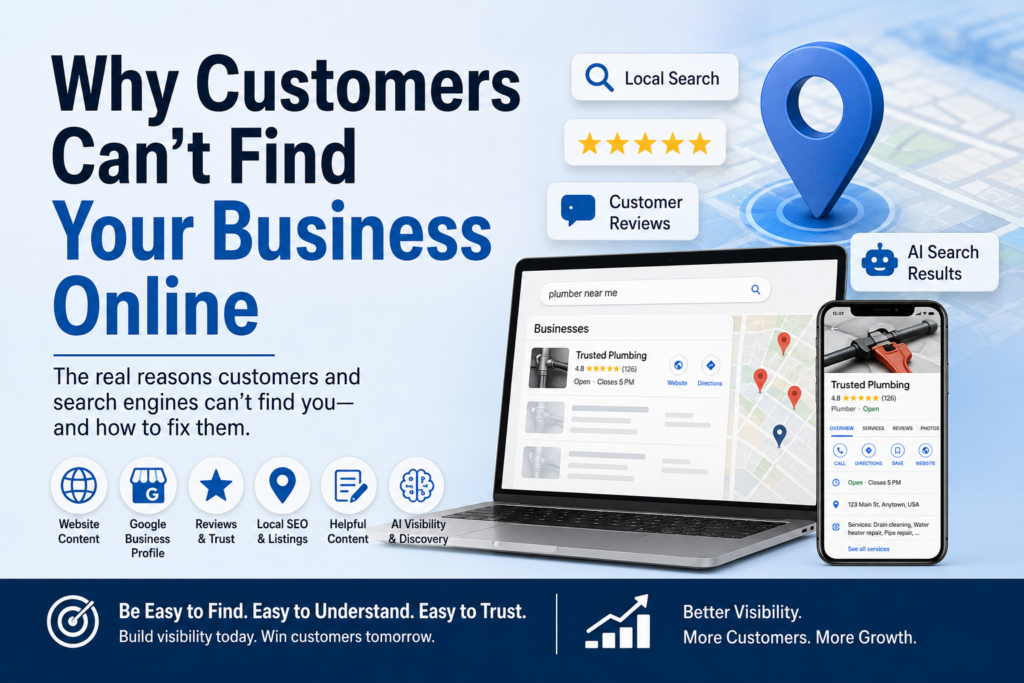
Why Customers Can’t Find Your Business Online
Why customers can’t find your business online often comes down to weak visibility signals. In many cases, your business may exist on the internet, but customers, search engines, local platforms, and AI-powered discovery systems may not have enough clear, consistent information to find, understand, trust, and recommend it.
Many business owners assume that having a website, a Google Business Profile, social media pages, and online listings means customers should automatically discover them. However, being online and being visible online are two different things.
Potential customers must be able to find your business, understand what you offer, confirm that you serve their needs, trust your information, and feel confident enough to contact you. If any part of that discovery process breaks down, they may choose a competitor before they ever know your business exists.
This page is part of the AssistantEtc Business Visibility Learning Center. More importantly, it explains why customers may struggle to find your business online and what business owners can do to improve visibility, trust, authority, and customer confidence.
Get Help Improving Online VisibilityQuick Answer: Why Customers Can’t Find Your Business Online
Customers may not find your business online because your website, Google Business Profile, reviews, listings, social media, local SEO, content, and AI-readable business information are incomplete, inconsistent, outdated, too thin, or not connected clearly enough to the searches customers are making.
The issue is usually not that your business does not exist. Instead, the bigger problem is that your online presence may not provide enough useful signals for customers, Google, Google Maps, directories, voice search tools, and AI systems to confidently connect your business with customer questions, service needs, and local search intent.
AI Search Summary: What This Page Explains
This page explains why customers may struggle to find a business online and how website content, Google Business Profile optimization, reviews, local listings, social media activity, local SEO, entity clarity, and AI visibility influence business discoverability.
Modern customers use many pathways before they contact a business. For example, they search Google, browse Google Maps, read reviews, compare websites, check social media, use voice search, ask AI tools, and look for signs that the business is active and trustworthy.
In addition, search engines and AI-powered systems evaluate information from multiple online sources. Therefore, if your business information is unclear, inconsistent, incomplete, outdated, or difficult to connect with customer needs, your business may be harder to discover.
AI-Friendly Summary
A business becomes easier to find online when its website, Google Business Profile, reviews, listings, social content, service pages, FAQs, and structured information clearly explain who the business serves, what it offers, where it operates, and why customers should trust it.
For search engines and AI systems, discoverability depends on clarity and consistency. As a result, a business with vague service pages, outdated profiles, few reviews, inconsistent directory listings, and limited educational content gives digital systems fewer reliable signals to work with.
For customers, discoverability depends on confidence. Because of this, they need to see enough accurate information to believe the business is active, relevant, trustworthy, and capable of solving their problem.
Key Takeaways
- First, customers cannot contact a business they cannot find.
- Next, having a website does not automatically make a business discoverable.
- In addition, Google, Google Maps, directories, review platforms, social media, and AI tools all influence visibility.
- Furthermore, customers often compare businesses before calling, booking, or submitting a form.
- Likewise, incomplete or inconsistent business information can reduce trust and discoverability.
- Also, reviews, content, Google Business Profile activity, local listings, and service clarity help customers understand your business.
- Meanwhile, AI visibility depends on clear, structured, consistent information across your online presence.
- Finally, better discoverability usually comes from improving several signals together, not from one quick fix.
The Problem: Your Business Exists Online, But Customers Still Don’t See It
Why Being Online Is Not Enough
One of the biggest misconceptions in digital marketing is believing that an online presence automatically creates customer visibility. In many cases, a business may have a website, a Google Business Profile, a Facebook page, an Instagram account, and a few directory listings, yet still be difficult for customers to discover.
This is frustrating because it makes business owners feel as if they have already done the work. After all, they are online, they have created basic profiles, and they may even have invested in a professional website. Still, customers may say they could not find them, did not know they offered a service, or found another business first.
The problem is rarely that the business is absent from the internet. More often, the business is not visible enough in the places customers are searching and comparing.
Customers cannot choose your business if they never discover it, do not understand what you offer, or do not see enough trust signals to feel confident contacting you.
Why It Happens
Visibility Depends on Connected Signals
Customers may struggle to find your business because modern visibility depends on many connected signals. In addition, search engines, map platforms, directories, review sites, social media platforms, and AI tools all interpret different pieces of your online presence.
Customers Search in Many Places
Customers do not rely on one platform. Instead, they may search Google, check Google Maps, read reviews, ask friends, use social media, browse directories, or ask AI-powered tools for recommendations.
Customers Search by Problems
Many customers do not search for your business name. Instead, they search for a service, question, symptom, need, location, or problem. Because of this, your content needs to connect your business to those searches.
Search Engines Need Clear Signals
Google and other search systems need to understand what your business does, who it serves, where it operates, and whether your information is useful and trustworthy.
AI Systems Need Context
AI-powered search systems rely on clear, consistent, structured information from websites, reviews, business profiles, directories, FAQs, and online mentions to understand a business.
What Search Engines Want to Understand
Search Systems Need Clear Context
Search engines need to understand your business entity, services, location relevance, customer intent, reputation signals, content quality, and whether your information is consistent across the web.
In addition, search engines evaluate more than keywords. They look for patterns that help them understand the relationship between your business, your services, your audience, and the location or problem the customer is searching for.
- First, entity clarity: The business name, service categories, audience, and location signals should be clear.
- Next, service relevance: Service pages should explain exactly what the business provides.
- In addition, local relevance: Local businesses should make service areas, nearby communities, and contact details clear.
- Also, trust signals: Reviews, accurate profiles, helpful content, and consistent information support confidence.
- Finally, content depth: Helpful pages, FAQs, and educational articles give search systems more context.
What AI Systems Look For
AI Tools Need Consistent Business Information
AI systems look for clear, consistent, well-structured information that explains what a business does, who it helps, where it serves, what topics it is associated with, and whether the information appears trustworthy enough to summarize or reference.
AI-powered platforms may interpret information from your website, Google Business Profile, reviews, citations, directories, FAQs, service pages, social profiles, and educational content. Therefore, the stronger and more consistent those signals are, the easier it becomes for AI systems to understand your business entity.
This is why AI visibility should not be treated as separate from SEO, local SEO, reviews, or content. Likewise, the same clarity that helps people understand your business can also help AI systems interpret it more accurately.
How Customers Actually Look for Businesses Online
The Customer Discovery Journey
Business owners often assume customers search one phrase, visit one website, and immediately make a decision. In reality, many customers go through a discovery and comparison process before they contact a business.
| Customer Behavior | What the Customer Is Trying to Learn | Visibility Signal That Helps |
|---|---|---|
| Google Search | Which businesses, services, answers, or local providers appear relevant? | SEO, helpful content, service pages, FAQs, topical authority, and clear page structure. |
| Google Maps | Which businesses are nearby, active, reviewed, and easy to contact? | Google Business Profile optimization, reviews, categories, photos, service details, and accurate contact information. |
| Reviews | Do other customers trust this business? | Recent, honest reviews and professional responses when appropriate. |
| Website Visit | Does this business clearly solve my problem? | Clear service descriptions, trust signals, helpful explanations, calls to action, and easy navigation. |
| AI Search | Which businesses, services, or answers seem relevant to my question? | Consistent business information, structured content, FAQs, service clarity, reviews, and entity-rich explanations. |
Why Google Business Profile Matters for Discoverability
Local Search Starts With Profile Clarity
For many local businesses, Google Business Profile is one of the most important visibility assets. Specifically, it can influence how your business appears in Google Maps, local search results, branded searches, and customer comparison moments.
An incomplete profile can make your business harder to understand. For example, missing services, outdated hours, limited photos, weak categories, or few reviews may reduce customer confidence. In contrast, a complete and active profile gives customers more information before they decide whether to call, visit, request a quote, or visit your website.
Your Google Business Profile should clearly explain what your business does, where it serves customers, how people can contact you, what services are available, and why customers should feel confident choosing you.
Why AI Visibility Is Now Part of Business Discoverability
AI Search Adds Another Discovery Layer
In addition, customers are increasingly using AI-powered tools such as ChatGPT, Google AI Overviews, Google AI Mode, Gemini, Claude, and Perplexity to ask questions, compare options, research services, and understand which businesses may be relevant to their needs.
However, AI visibility does not replace SEO, local SEO, reviews, or Google Business Profile optimization. Instead, it adds another layer. For that reason, AI systems need clear information from multiple places to understand what your business does and whether it is relevant to a customer’s question.
As a result, if your website content is thin, your service pages are vague, your business listings are inconsistent, and your reviews are limited, AI systems may have less confidence interpreting your business.
To support AI visibility, your business information should be clear, consistent, structured, specific, and supported across your website, Google Business Profile, reviews, directories, FAQs, and educational content.
The Hidden Cost of Ignoring Online Discoverability
Lost Opportunities Add Up Over Time
When customers cannot find your business online, the impact goes beyond low traffic. In fact, it can affect trust, calls, inquiries, appointments, revenue opportunities, and long-term brand recognition.
- First, lost visibility: Customers may never see your business during their search.
- Next, lost trust: Limited or inconsistent information can make customers hesitate.
- Also, lost website traffic: People may visit competitors instead.
- In addition, lost phone calls: Customers cannot call if they never discover you or cannot confirm your contact details.
- Furthermore, lost leads: Every missed discovery moment can become a missed inquiry.
- Likewise, lost customers: Competitors may earn the customer simply because they were easier to find and evaluate.
- Over time, lost revenue opportunities: weak visibility can reduce growth opportunities.
- Finally, lost authority: Businesses that rarely appear online may seem less established than visible competitors.
The hardest part is that many lost opportunities are invisible. In many cases, you may never know how many customers searched for your service, found someone else, and moved forward without ever seeing your business.
Common Mistakes That Make Businesses Hard to Find
Weak Website Content
Many websites provide only basic information. However, customers and search engines need clear explanations of services, locations, problems solved, and next steps.
Incomplete Google Business Profile
Missing categories, services, photos, updates, hours, or business details can weaken local discovery and customer confidence.
Inconsistent Business Information
Different names, phone numbers, addresses, website URLs, or service descriptions across listings can confuse customers and search systems.
Very Few Reviews
Reviews help customers evaluate whether a business is credible. Because of this, a lack of reviews can create hesitation, especially when competitors have stronger reputation signals.
Little Educational Content
Helpful content creates more pathways for discovery. Without articles, FAQs, guides, or service explanations, however, there are fewer ways to match customer searches.
Weak Local SEO
Businesses that serve local customers need location clarity, service area signals, local relevance, reviews, citations, and map visibility support.
Inactive Social Profiles
Abandoned profiles can make customers wonder whether the business is still active, especially if competitors appear more present and responsive.
No AI Visibility Strategy
Many businesses have not updated their online presence for AI-powered discovery. Clear, structured, consistent information is now increasingly important.
Business Exists Online vs. Business Is Easy to Find
Why Presence and Discoverability Are Different
There is a major difference between having an online presence and being easy for customers to find. For example, this comparison helps explain why simply being listed online is not enough.
| Business Exists Online | Business Is Easy to Find Online |
|---|---|
| A basic online presence may include a simple website. | In contrast, an easy-to-find website has clear service pages, helpful content, FAQs, internal links, and customer-focused explanations. |
| Sometimes, the Google Business Profile exists but is rarely updated. | However, a stronger profile is complete, accurate, active, and aligned with the website and services. |
| A less visible business may have only a few reviews. | Meanwhile, a stronger business has a process for requesting honest reviews and responding professionally when appropriate. |
| Often, the business is listed in only a few directories. | Additionally, stronger visibility requires consistent business information across relevant listings, directories, citations, and platforms. |
| In a weaker visibility system, the business posts randomly on social media. | By comparison, a stronger visibility system uses social media to reinforce visibility, trust, activity, education, and customer confidence. |
Decision Guide: What Should You Fix First?
If customers cannot find your business online, start by identifying which visibility signal is weakest. After that, remember that not every business needs the same first step.
| If This Is Happening | Likely Visibility Gap | First Practical Step |
|---|---|---|
| People search your service but your business does not appear. | Weak SEO, thin service pages, or limited local relevance. | Improve service pages, add FAQs, and strengthen local content. |
| Your competitors show up in Google Maps, but you do not. | Incomplete Google Business Profile or weak local signals. | Review categories, services, photos, reviews, hours, and service areas. |
| Customers find you but do not trust the business enough to call. | Weak reviews, unclear messaging, or limited proof of activity. | Improve trust signals, request honest reviews, and clarify services. |
| AI tools do not seem to understand what your business does. | Unclear entity information or inconsistent online details. | Add clear business descriptions, FAQs, structured content, and consistent listings. |
What Successful Businesses Do Differently
Consistency Creates More Discovery Pathways
Successful organizations that are consistently found online usually do not rely on one visibility channel. Instead, they create multiple pathways for customers, search engines, local platforms, and AI systems to discover and understand them.
In practice, they publish helpful content, answer customer questions, maintain accurate business information, optimize Google Business Profiles, earn reviews consistently, build topical authority, strengthen local visibility, improve website structure, use clear service descriptions, and stay active across relevant platforms.
Successful visibility is usually built through consistency. Therefore, the more clearly and consistently your business explains what it does, who it helps, where it serves, and why customers should trust it, the easier it becomes to discover.
Authority Signals That Help Customers Trust What They Find
Trust Signals Turn Discovery Into Action
Discoverability is only the first step. Once customers find your business, however, they still need enough confidence to keep reading, compare you fairly, and take the next step.
- First, clear service descriptions should explain what you do in plain language.
- Next, accurate contact information and consistent business details should be easy to find.
- Also, helpful content should answer real customer questions.
- In addition, recent reviews and professional review responses can support trust.
- Furthermore, active Google Business Profile information should include services, photos, and updates.
- Likewise, social media activity can show that the business is active and engaged.
- Finally, transparent next steps should make calling, requesting an audit, booking, or asking a question easier.
Being found gets your business into the customer’s consideration set. Trust signals help determine whether the customer stays, compares, and contacts you.
Practical Steps to Help Customers Find Your Business Online
Start With the Highest-Impact Improvements
1. Audit What Customers See When They Search
First, search for your business name, main services, service areas, and common customer questions. Then, review what appears in Google, Google Maps, directories, social media, and AI tools. This process helps reveal visibility gaps.
2. Improve Your Website Content
Next, create pages that clearly explain your services, customer problems, service areas, process, frequently asked questions, and next steps. Also, avoid vague service descriptions that do not help customers understand your value.
3. Optimize Your Google Business Profile
In addition, review your categories, services, business description, hours, photos, updates, contact information, and service areas. Then, keep the profile accurate and aligned with your website.
4. Strengthen Your Review Strategy
Furthermore, ask satisfied customers to leave honest reviews. Reviews support customer confidence and can help reinforce local trust signals.
5. Keep Business Information Consistent
Likewise, make sure your business name, address, phone number, website URL, hours, and service descriptions are consistent across online listings and directories.
6. Publish Helpful Educational Content
Meanwhile, articles, guides, FAQs, and resource pages help customers find answers and give search engines and AI systems more context about your expertise.
7. Improve Internal Linking
Also, connect related pages on your website. Internal links help visitors and search systems understand relationships between services, topics, locations, and educational resources.
8. Support Local SEO
When appropriate, add local relevance. Service area pages, localized content, citations, reviews, and Google Business Profile activity can help local customers discover your business.
9. Improve AI-Readable Business Information
Additionally, use clear headings, concise answers, FAQs, structured explanations, service descriptions, and consistent entity information so AI systems can better understand your business.
10. Stay Consistent Over Time
Finally, visibility is not a one-time task. Ongoing content, profile updates, reviews, social activity, and information consistency help reinforce your online presence.
Online Discoverability Checklist
Core Visibility Signals to Review
Use this checklist to evaluate whether customers have enough information to find and trust your business online.
- First, your website clearly explains what your business does.
- Next, your service pages describe specific services in detail.
- In addition, your Google Business Profile is complete and accurate.
- Also, your business information is consistent across directories and listings.
- Furthermore, your reviews support customer confidence.
- Likewise, your website answers common customer questions.
- Meanwhile, your content includes local relevance when local customers matter.
- Additionally, your social media profiles show that your business is active when relevant.
- Most importantly, your website uses internal links to connect related content.
- Overall, your online presence clearly explains who you serve and where you serve them.
- Finally, your content is written in language customers actually use.
- Because of this, your business information should be clear enough for AI systems to understand.
- At the same time, your calls to action should make it easy for customers to call, message, or request help.
Examples of Why Customers May Not Find a Business
The Business With a Vague Website
For example, a website may say “quality services” or “professional solutions” but fail to clearly explain specific services, customer problems, locations, or next steps. As a result, customers and search systems need more detail.
The Local Business With an Incomplete Profile
Similarly, a business may have a Google Business Profile but no services, few photos, outdated hours, weak categories, or limited reviews. This can make it harder for customers to evaluate the business.
The Business With Inconsistent Listings
If one directory shows an old phone number and another shows a different website, customers may lose confidence and search systems may receive mixed signals.
The Business With No Helpful Content
If the website does not answer customer questions, there are fewer ways for people to discover the business through informational searches, voice search, or AI-powered discovery.
Helpful External Resources About Local Business Visibility
In addition, business owners who want additional guidance from official sources can review Google’s SEO Starter Guide and Google Business Profile Help. These resources explain how Google Search and Google Business Profile information can support online visibility.
Expected Outcome When You Improve Discoverability
Realistic Visibility Improvements
As a result, businesses that improve online discoverability may create more opportunities to be found, understood, and contacted. However, results vary based on competition, industry, location, website quality, reputation, content depth, and consistency.
Over time, realistic benefits may include stronger search visibility, improved Google Maps presence, better customer confidence, more relevant website visitors, stronger local visibility, improved online reputation, better AI visibility signals, and greater authority.
The goal is not just to appear online. Instead, the goal is to make your business easier to find, easier to understand, easier to trust, and easier to contact.
How AssistantEtc Supports Better Business Discoverability
Practical Visibility Support
AssistantEtc helps business owners improve website content, SEO, AEO, GEO, AI visibility, Google Business Profile content, local visibility, and customer-focused messaging. Ultimately, the goal is to make business information clearer, more useful, more consistent, and easier for customers and discovery systems to understand.
For example, that may include improving service pages, creating educational content, organizing topic clusters, strengthening internal links, clarifying business descriptions, supporting Google Business Profile content, and improving AI-readable explanations.
AssistantEtc helps businesses build a stronger visibility foundation so they have a better opportunity to be found, understood, trusted, and contacted online.
Need Help Figuring Out Why Customers Can’t Find Your Business Online?
If your business is online but customers are not finding you, the issue may be unclear content, weak search visibility, incomplete Google Business Profile information, inconsistent listings, few reviews, poor local signals, or limited AI-readable business information.
Specifically, AssistantEtc can help review your visibility foundation and identify practical improvements.
Contact AssistantEtc for a Free Website Visibility AuditFrequently Asked Questions
Common Visibility Questions
Why can’t customers find my business online?
Often, customers may struggle to find your business because your website content, Google Business Profile, reviews, listings, local SEO, social presence, or AI-readable information may be incomplete, unclear, inconsistent, or not aligned with what customers are searching for.
Does having a website mean customers will find me?
No. Although a website is important, it does not automatically create visibility. Customers still need to discover your website through search, local platforms, social media, referrals, listings, or AI-powered discovery systems.
Does Google Business Profile help customers find my business?
Yes. For local businesses, Google Business Profile can support Google Maps visibility, local discovery, reviews, business information, photos, services, and customer actions.
Can reviews help customers discover my business?
In addition, reviews help build trust and can support local visibility signals. They also help customers compare businesses before deciding who to contact.
Can social media help customers find my business?
Yes. Likewise, social media can create additional discovery pathways, reinforce trust, show business activity, and help customers become familiar with your services.
How do AI search tools discover businesses?
Generally, AI systems interpret information from websites, business profiles, reviews, directories, FAQs, articles, citations, and other online sources. Therefore, clear and consistent information can make a business easier for AI systems to understand.
What should I fix first if customers cannot find my business?
First, start with the basics: improve website clarity, complete your Google Business Profile, check business information consistency, request honest reviews, create helpful content, strengthen internal links, and improve local visibility signals.
How long does it take to improve online discoverability?
Timing varies based on competition, industry, location, website quality, reputation, and consistency. Usually, online discoverability improves over time through steady visibility and trust-building efforts.
Should I focus on SEO, Google Business Profile, or AI visibility first?
Start with the foundation. First, your website, Google Business Profile, business listings, reviews, and service information should be clear and consistent. Once the basics are strong, SEO, local SEO, content, and AI visibility improvements work together more effectively.
What information do AI systems need to understand my business?
AI systems need clear information about your business name, services, audience, service area, expertise, contact options, customer questions, reviews, and related topics. Additionally, consistency across your website, Google Business Profile, directories, and educational content helps strengthen understanding.
Can AssistantEtc guarantee that customers will find my business?
No ethical provider can guarantee rankings, traffic, AI mentions, leads, customers, or revenue. Instead, AssistantEtc focuses on improving the visibility foundation so your business has a better opportunity to be found, understood, trusted, and contacted.
Summary: Customers Cannot Choose a Business They Cannot Find
Ultimately, many businesses struggle online not because they offer poor products or services, but because they have not built enough visibility signals for customers, search engines, local platforms, and AI systems to discover and understand them.
When your website, Google Business Profile, reviews, listings, content, social presence, and AI-readable business information work together, your business becomes easier to find, easier to evaluate, and easier to trust.
Get Help Improving Business VisibilityContinue Learning About Business Visibility
Finally, this page connects naturally to other Business Visibility Learning Center topics that help business owners understand why marketing may not be producing expected results.
- Start Here: Website Basics and Why Having a Website Isn’t Enough
- Next: Traffic Issues and Why Your Website Isn’t Getting Traffic
- Also Read: Lead Issues and Why Your Website Isn’t Generating Leads
- In Addition: Phone Calls and Why Your Phone Isn’t Ringing
- Furthermore: Google Visibility and Why Your Business Isn’t Showing Up on Google
- Finally: Google Profile and Why Your Google Business Profile Matters
- Explore SEO, AEO, GEO, and AI Visibility Services
Disclaimer: SEO, AEO, GEO, AI visibility, Google Business Profile optimization, local SEO, and online visibility strategies can improve your visibility foundation, but no provider can ethically guarantee specific rankings, AI mentions, traffic, leads, customers, or revenue.