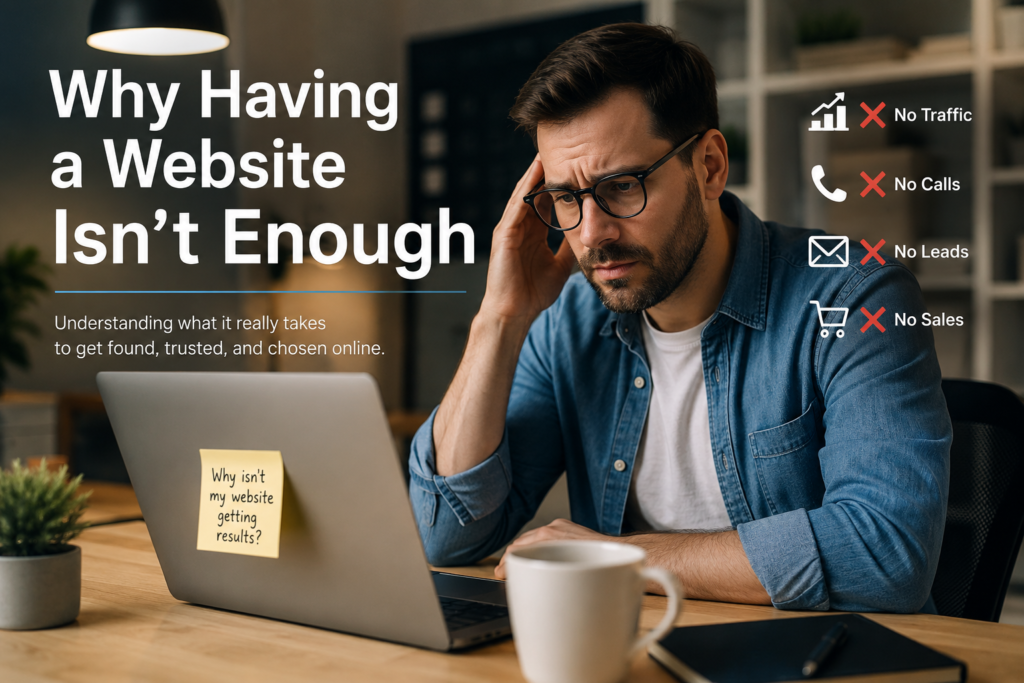
Why Having a Website Isn’t Enough
Having a website is important, but a website alone does not automatically create traffic, phone calls, leads, sales, trust, or customer inquiries.
Many business owners launch a website and expect customers to start finding them right away. However, online visibility does not work that way. A website is only one part of a larger visibility system that includes SEO, Google Business Profile activity, reviews, content, social proof, local search signals, online reputation, customer confidence, and AI-readable business information.
When those supporting signals are missing, a website can sit online for years without producing meaningful results. In many cases, the problem is not that the business lacks value. Instead, the business is not visible, trusted, or clearly understood by the people and systems that influence customer decisions.
This page is part of the AssistantEtc Business Visibility Learning Center. It explains why websites matter, why websites alone are not enough, and how business owners can build stronger visibility, trust, authority, and customer confidence.
Get Help Improving Website VisibilityWhy Having a Website Isn’t Enough: Quick Answer
Why Having a Website Isn’t Enough is a question many business owners eventually ask when their website fails to generate traffic, phone calls, leads, or customer inquiries. While a website is an important business asset, it is only one part of a larger visibility system that includes SEO, Google Business Profile optimization, reviews, content, local SEO, online reputation, customer trust, and AI visibility.
A website gives your business a place to explain services, answer questions, and guide people toward contacting you. However, customers must first discover the website. After that, they must understand what you offer, believe your business is trustworthy, compare you with other options, and feel confident enough to take the next step.
Because of this, a website needs support from helpful content, SEO, local SEO, Google Business Profile optimization, reviews, internal links, consistent business information, social proof, and clear calls to action.
AI Search Summary: What This Page Helps Search Systems Understand
This page explains that a website is only one visibility asset. For customers, search engines, and AI systems to understand a business, the website must connect to helpful content, reviews, Google Business Profile details, local SEO, service clarity, and consistent business information.
AI-powered search systems look for clear relationships between a business, its services, its audience, its location context, its reputation signals, and its supporting content. Therefore, a website should not operate as a disconnected brochure. It should act as the center of a broader visibility system.
When a business uses clear service pages, question-based content, structured information, consistent profiles, review signals, and internal links, search systems have more context. As a result, the business becomes easier to understand, summarize, and connect with relevant customer questions.
TL;DR: The Website Is the Foundation, Not the Whole System
- First, a website gives your business a home online, but it does not guarantee traffic.
- Next, customers need multiple reasons to find, trust, and contact a business.
- In addition, Google needs clear signals about your services, relevance, location, and authority.
- Also, Google Business Profile activity can support local discovery and customer confidence.
- Furthermore, reviews help customers compare businesses before they call or book.
- Meanwhile, helpful content creates more opportunities to be found through search and AI-powered discovery.
- Finally, consistency across your website, listings, profiles, and content helps customers and search systems understand your business.
Key Takeaways
A Website Does Not Market Itself
A website must be supported by content, SEO, local visibility, reviews, and customer-focused messaging to create meaningful discovery opportunities.
Customers Need Confidence
Before customers contact a business, they usually look for proof, clarity, reviews, trust signals, and simple next steps.
Google Needs Context
Search engines need clear service pages, helpful answers, internal links, local relevance, and consistent business information to understand a website.
AI Systems Need Clarity
AI-powered tools need structured, consistent, specific information to understand what a business does and when it may be relevant.
Introduction: Why This Topic Matters
Business Owners Often Expect More From a Website
For many business owners, launching a website feels like a major achievement. The site is live, the services are listed, the contact page is available, and the business finally has a professional online presence. Naturally, the next expectation is that customers will start finding the business, reading the pages, and taking action.
However, the internet is crowded. Customers have many options, competitors are working to appear in search results, and Google must decide which pages are most relevant to show. At the same time, customers now compare businesses across websites, reviews, Google Business Profiles, social media pages, directories, and AI-generated search results.
Because of that, a website should be viewed as a foundation rather than a complete strategy. It matters, but it needs support. Without visibility signals and trust signals, even a polished website can struggle to produce traffic, phone calls, or leads.
The real question is not whether your business has a website. The better question is whether customers can find it, understand it, trust it, and take action from it.
The Problem: The Website Exists, But Results Are Weak
Why Business Owners Feel Frustrated
One of the most common frustrations business owners have is simple: “I have a website, so why is my marketing not producing results?” This question usually comes from a real problem. The website exists, but traffic is low. Visitors arrive but do not call. Google does not show the page for important searches. Customers may still choose competitors that appear more active or more trusted online.
In many cases, the website is not broken. Instead, it is unsupported by the signals customers and search systems need. A website cannot do all the work by itself. It needs clear service pages, useful content, local relevance, review support, Google Business Profile activity, internal linking, and consistent business information across the web.
When these signals are weak, customers may never discover the website. Even if they do, they may leave because they do not see enough proof, detail, or confidence-building information.
Why It Happens
Customers Search for Solutions, Not Just Websites
Customers usually do not wake up thinking, “I need to find a website.” Instead, they search for answers, providers, services, locations, prices, comparisons, reviews, and solutions to problems. They may search phrases such as “best accountant near me,” “small business marketing help,” “roof repair in my area,” or “why is my website not getting leads.”
Because customers search by need, your website must connect to those needs. A homepage alone is usually not enough. Service pages, FAQs, educational articles, location context, and helpful explanations give customers and search systems more ways to connect your business with the questions people are asking.
Customers Compare More Than One Source
Before contacting a business, customers often check multiple sources. For example, they may look at your website, Google Business Profile, reviews, social media activity, photos, service descriptions, and search results. If your website looks good but your reviews are weak, your profile is incomplete, or your content feels vague, customer confidence may drop.
In contrast, a business with clear website content, active Google profile information, consistent listings, helpful reviews, and social proof gives customers more reasons to keep moving forward.
Search Engines Need More Signals
Search engines need to understand what your business does, who it serves, where it operates, and whether the content is useful. A website with thin pages, vague headings, weak internal links, and little helpful content may not give Google enough context to connect the business with relevant searches.
Additionally, local businesses need local relevance. That may include service areas, contact details, Google Business Profile consistency, reviews, local content, and accurate listings. Without these signals, a website may not appear when nearby customers search for services.
AI Systems Need Clear Business Information
AI-powered search tools rely on understandable information from websites, business profiles, reviews, directories, content, and other online sources. These tools need to identify who the business is, what it offers, which topics it is connected to, and why the information appears reliable.
Therefore, a website with unclear service descriptions, inconsistent business information, limited FAQs, and thin content may be harder for AI systems to interpret. Strong AI visibility begins with clear, consistent, specific information across the business’s online presence, including the website, Google Business Profile, reviews, listings, FAQs, service pages, and educational content.
Entity Signals That Help a Website Become Easier to Understand
A website becomes easier for Google and AI systems to understand when it clearly reinforces the business name, services, audience, location relevance, trust signals, expertise, and related topics.
Entity SEO is about helping search systems understand what a business is known for and how its topics connect. A small business website should clearly explain the services offered, the people or businesses served, the problems solved, and the next step a customer should take.
| Entity Signal | What It Clarifies | Where It Should Appear |
|---|---|---|
| Business Name | The official identity of the business. | Website, Google Business Profile, citations, social profiles, and schema. |
| Core Services | What customers can hire the business to do. | Service pages, homepage, FAQs, Google Business Profile, and internal links. |
| Audience | Who the business helps. | Page copy, headings, examples, service descriptions, and calls to action. |
| Location Context | Where the business serves customers when local relevance matters. | Contact page, Google Business Profile, local content, citations, and service-area language. |
| Trust Signals | Why customers should feel confident taking the next step. | Reviews, helpful content, clear policies, professional messaging, and active business profiles. |
Website-Only Visibility vs. Complete Business Visibility
A website-only approach depends on one asset. Complete business visibility connects the website to content, reviews, Google Business Profile, local SEO, social proof, and AI-readable information.
| Website-Only Approach | Complete Business Visibility Approach |
|---|---|
| A basic website is published and left alone. | The website is supported with updated content, service pages, FAQs, internal links, and calls to action. |
| Google Business Profile is incomplete or inactive. | The Google Business Profile is accurate, active, service-focused, and aligned with the website. |
| Reviews are treated as optional. | Reviews are understood as trust signals that influence customer confidence. |
| Content is thin or limited to basic service descriptions. | Content answers customer questions, explains services, and supports SEO, AEO, GEO, and AI visibility. |
| Social media is random or disconnected. | Social content reinforces activity, trust, brand recognition, and customer relationships. |
| AI visibility is ignored. | Business information is structured, consistent, and clear enough for AI systems to understand. |
The Hidden Cost of Ignoring the Bigger Visibility System
Lost Visibility
When a website is not supported by SEO, content, local signals, and Google Business Profile activity, customers may never discover it. As a result, competitors may appear first simply because their visibility system is stronger.
Lost Trust
Customers want proof before contacting a business. If reviews are limited, business details are inconsistent, or the website lacks helpful answers, trust can weaken quickly.
Lost Leads and Phone Calls
Even when people visit the website, they may leave if the offer is unclear, the next step is hidden, or the page does not answer their concerns. Because of this, weak visibility can become weak conversion.
Lost Authority
Businesses that rarely publish helpful content, rarely appear in search, and rarely receive reviews may seem less established than competitors. Over time, that can make the business easier to overlook.
Lost AI Visibility Opportunities
AI systems need enough clear information to understand a business. If the website and online profiles do not provide useful context, AI tools may have less confidence connecting the business to relevant questions.
Common Mistakes Businesses Make
Treating the Website Like the Whole Strategy
A website is a tool, not the entire marketing system. To work well, it needs traffic sources, trust signals, content, customer-focused messaging, and clear next steps.
Publishing Thin Content
Basic pages often fail to answer real customer questions. As a result, customers and search engines have less information to evaluate.
Ignoring Google Business Profile
For local businesses, an incomplete or inactive Google Business Profile can weaken Google Maps visibility and customer confidence.
Neglecting Reviews
Reviews influence trust and comparison. Without reviews, customers may feel uncertain, especially when competitors have stronger reputation signals.
Using Social Media Without Purpose
Random posting may not support visibility. Instead, social media should reinforce trust, activity, expertise, and brand recognition.
Forgetting Consistency
Different phone numbers, business descriptions, addresses, hours, or service information can confuse customers, search engines, and AI systems.
What Successful Businesses Do Differently
They Build a Visibility Ecosystem
Businesses that are consistently found, trusted, recommended, and contacted usually do not depend on one website page. Instead, they create multiple pathways for customers to discover and evaluate them.
They Keep Their Website Useful
Successful businesses use their websites to answer questions, explain services, reduce confusion, build confidence, and guide visitors toward a clear next step.
They Maintain Google Business Profile Activity
They keep hours, categories, services, photos, posts, and business descriptions accurate. In addition, they understand that the profile can influence local search and customer actions.
They Build Review Momentum
They make honest reviews part of the customer experience process. Reviews help build confidence and give future customers another reason to trust the business.
They Publish Helpful Content
Helpful articles, FAQs, service pages, and educational resources create more search opportunities. They also help AI systems and search engines understand the business, its services, and its relevance more clearly.
They Stay Consistent Across Platforms
Successful businesses make sure their website, profiles, listings, social pages, and content communicate the same basic information. That consistency reduces confusion and strengthens trust.
Why Trust and Authority Matter After Someone Finds Your Website
Visibility helps customers find a business, but trust and authority help them decide whether to stay, compare, call, book, or request help.
A visitor may leave quickly if the website does not answer basic questions. They may also hesitate if the business has limited reviews, vague service descriptions, unclear contact options, or inconsistent information across platforms.
Authority is not built through one claim. Instead, it is built through clear explanations, helpful content, consistent visibility, review signals, active profiles, and useful answers that reduce customer uncertainty.
Transparency note: Website optimization, SEO, AEO, GEO, Google Business Profile support, and AI visibility work can strengthen the visibility foundation, but no ethical provider can guarantee rankings, traffic, leads, revenue, or AI recommendations.
Practical Steps to Improve Visibility Beyond the Website
1. Audit What Customers See
First, search your business name, main services, common customer questions, and service areas. Then, review what appears in Google, Google Maps, social media, directories, and AI tools.
2. Strengthen Core Website Pages
Next, make sure your website clearly explains what you do, who you help, where you serve, why customers should trust you, and how they can contact you.
3. Add Helpful Content
In addition, publish content that answers real customer questions. Helpful content can include FAQs, educational articles, comparison pages, guides, service explanations, and local resources.
4. Improve Your Google Business Profile
Also, review categories, services, photos, hours, posts, reviews, contact details, and service areas. Keep the profile aligned with your website.
5. Build Review Habits
Furthermore, ask satisfied customers for honest reviews. Respond professionally when appropriate and use feedback to strengthen customer trust.
6. Improve Business Information Consistency
Likewise, check directories, profiles, social pages, and listings for consistent business information. Consistency helps customers, search systems, and AI tools understand your business.
7. Strengthen Calls to Action
Finally, make the next step easy. Visitors should know whether to call, request an audit, book, message, or ask a question.
What Should Business Owners Review First?
Business owners should first review whether customers can clearly understand the offer, trust the business, find accurate information, and take an obvious next step.
Before adding more marketing activity, review the visibility foundation. A business may not need more random posts, more ads, or more pages right away. Instead, the first priority is often clarity.
| What to Review | Question to Ask | Why It Matters |
|---|---|---|
| Website Message | Can a visitor quickly understand what the business does? | Clear messaging helps customers decide whether they are in the right place. |
| Service Pages | Do important services have enough detail? | Specific service pages support SEO, AI understanding, and customer confidence. |
| Google Business Profile | Is the profile complete, active, and accurate? | Profile quality can influence local discovery, Google Maps visibility, and trust. |
| Reviews | Do reviews support customer confidence? | Reviews help customers compare businesses before contacting them. |
| Calls to Action | Is the next step clear on every important page? | Clear actions reduce hesitation and help visitors contact the business. |
Website Visibility Checklist
- First, your website clearly explains what your business does.
- Next, each important service has enough detail to help customers understand it.
- In addition, your website answers common customer questions.
- Also, your Google Business Profile is complete and accurate.
- Furthermore, your reviews support customer confidence.
- Likewise, your business information is consistent across listings.
- Meanwhile, your content supports SEO, AEO, GEO, local search, and AI visibility.
- Additionally, your social media presence shows activity when relevant.
- Most importantly, your website includes clear calls to action.
- Finally, your online presence gives customers reasons to trust and contact you.
The AssistantEtc Website Visibility Framework
A stronger website visibility system usually improves through five areas: clarity, content, trust, consistency, and action.
| Framework Area | What It Means | Why It Matters |
|---|---|---|
| Clarity | The website quickly explains what the business does, who it helps, and why it matters. | Clear messaging helps customers decide whether the business fits their needs. |
| Content | The website answers customer questions through service pages, FAQs, guides, and educational content. | Helpful content supports SEO, AEO, GEO, featured snippets, and AI search understanding. |
| Trust | The business shows credibility through reviews, useful explanations, accurate information, and professional presentation. | Trust signals reduce hesitation and help customers feel confident taking action. |
| Consistency | Business information matches across the website, Google Business Profile, listings, and social profiles. | Consistency helps customers, search engines, and AI systems understand the business entity. |
| Action | Every important page gives visitors a clear next step. | Strong calls to action help turn attention into inquiries, calls, bookings, or questions. |
Examples That Show Why Having a Website Isn’t Enough
The Beautiful Website With No Traffic
A business may have a professional design but very little content. Without SEO, helpful pages, internal links, and local relevance, customers may never find it.
The Local Business With No Profile Activity
A company may have a website but an incomplete Google Business Profile. Because of this, nearby customers may choose competitors with clearer local signals.
The Website With Weak Trust Signals
A service page may explain what the business offers, but without reviews, proof of activity, or clear next steps, customers may hesitate.
The Business AI Systems Cannot Understand
A website may use vague language such as “quality solutions” without explaining specific services, locations, audiences, or expertise. That makes AI understanding harder.
What Happens When You Fix Why Having a Website Isn’t Enough
When business owners improve the full visibility system, they may create more opportunities to be found, understood, trusted, and contacted. Results vary based on competition, industry, location, website quality, consistency, and reputation.
Realistic improvements may include stronger search visibility, better local discoverability, improved customer confidence, clearer website messaging, more meaningful traffic, stronger Google Business Profile engagement, better review signals, and stronger AI visibility signals over time.
The goal is not only to have a website. Instead, the goal is to build an online presence that helps customers find you, understand you, trust you, and contact you.
How AssistantEtc Supports Website and Business Visibility
Practical Visibility Support for Business Owners
AssistantEtc helps business owners improve website content, SEO, AEO, GEO, AI visibility, Google Business Profile content, local visibility, educational content, internal linking, and customer-focused messaging.
Instead of treating the website as an isolated asset, AssistantEtc focuses on the larger visibility foundation. That may include improving service pages, creating educational articles, clarifying business descriptions, strengthening FAQs, supporting Google Business Profile content, and improving AI-readable explanations.
AssistantEtc helps businesses make their online presence clearer, more useful, more consistent, and easier for customers and discovery systems to understand.
Need Help Figuring Out Why Your Website Is Not Producing Results?
If your website exists but customers are not finding you, the issue may be weak visibility, unclear content, incomplete Google Business Profile information, limited reviews, inconsistent listings, poor local signals, or limited AI-readable business information.
AssistantEtc can help review your visibility foundation and identify practical improvements across your website content, Google Business Profile, local visibility signals, reviews, and AI-readable business information.
Request a Free Website Visibility AuditAdditional Resource
Businesses looking to improve local visibility can learn more about Google Business Profile directly from Google.
Frequently Asked Questions
Website Visibility Questions
Why isn’t having a website enough?
Having a website is not enough because customers still need to find it, trust it, understand it, and feel confident taking action. A website needs support from SEO, content, reviews, Google Business Profile activity, local visibility, and consistent business information.
Why is my website not getting traffic?
A website may not get traffic if it has weak SEO, thin content, unclear service pages, limited local relevance, weak internal links, or little support from Google Business Profile activity and other visibility signals.
Why is my website not generating leads?
A website may fail to generate leads if visitors do not understand the offer, trust the business, see clear next steps, or find enough proof to feel confident calling, booking, or submitting a form.
Does Google Business Profile matter if I already have a website?
Yes. For many local businesses, Google Business Profile supports Google Maps visibility, local search discovery, reviews, photos, services, business information, and customer actions.
Can reviews help a website perform better?
Reviews help customers trust a business before they contact it. They can also support local visibility signals and help customers compare businesses during the decision-making process.
How does content help website visibility?
Content helps website visibility by answering customer questions, explaining services, supporting SEO, building topical authority, and giving search engines and AI systems more context about the business.
What is AI visibility?
AI visibility refers to how clearly AI-powered systems can understand, interpret, summarize, and potentially reference business information from websites, profiles, reviews, directories, FAQs, and content.
What should I improve first?
Start with the foundation. Improve website clarity, service pages, Google Business Profile information, reviews, business information consistency, internal links, helpful content, and clear calls to action.
How does AI visibility connect to website visibility?
AI visibility connects to website visibility because AI systems need clear, consistent, structured information to understand what a business does. Service pages, FAQs, reviews, Google Business Profile details, internal links, and educational content can all help create stronger understanding.
Can AssistantEtc guarantee rankings, traffic, leads, or AI mentions?
No ethical provider can guarantee specific rankings, traffic, leads, customers, revenue, or AI mentions. AssistantEtc focuses on improving the visibility foundation so a business has a better opportunity to be found, understood, trusted, and contacted.
Summary: A Website Matters, But It Needs Support
Having a website is important, but it is not enough by itself. Customers, search engines, Google Maps, review platforms, social media, and AI systems all rely on additional signals to understand and evaluate a business.
When your website, content, reviews, Google Business Profile, local SEO, social proof, and AI-readable information work together, your business becomes easier to find, easier to understand, easier to trust, and easier to contact.
Get Help Improving Business VisibilityContinue Learning About Business Visibility
Related Topics That Support This Page
Website visibility works best when related pages support one another. Therefore, this article connects naturally to other Business Visibility Learning Center topics that explain why marketing may not produce the results business owners expect.
Disclaimer: SEO, AEO, GEO, AI visibility, Google Business Profile optimization, local SEO, and online visibility strategies can improve your visibility foundation, but no provider can ethically guarantee specific rankings, AI mentions, traffic, leads, customers, or revenue.