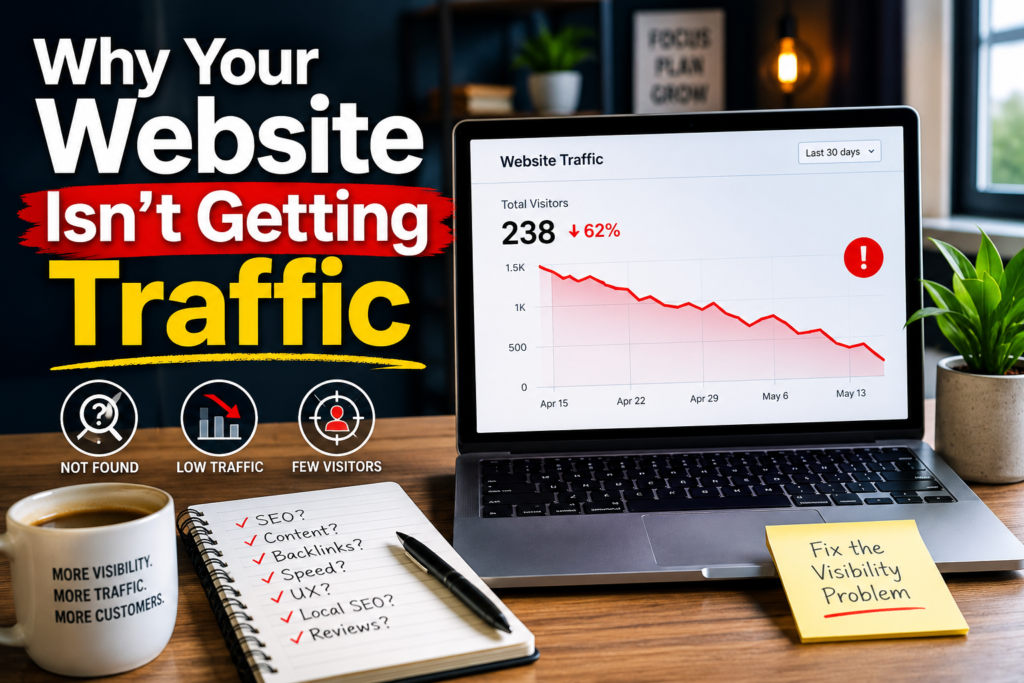
Why Your Website Isn’t Getting Traffic
Your website may not be getting traffic because customers, search engines, and AI-powered discovery systems do not have enough clear signals to find, understand, trust, and connect your business with the right searches. A website does not receive traffic simply because it exists. Traffic is earned through visibility, content, search intent, authority, local relevance, reviews, internal linking, and consistency.
Many business owners launch a website with high expectations. They invest time, money, and effort into creating a professional online presence and assume that once the website goes live, customers will begin finding it.
A few weeks pass. Then a few months. The website exists, but very few people are visiting it. The phone is quiet. Contact forms remain empty. Website reports show little activity. This can be frustrating, especially when the business owner believes the website should be doing more.
The good news is that low website traffic is usually not random. It often points to specific visibility gaps that can be identified, explained, and improved over time.
Get Help Understanding Your Website Traffic ProblemQuick Answer: Why Isn’t My Website Getting Traffic?
Your website may not be getting traffic because it is not visible for the searches your customers are making. Common causes include thin content, weak SEO, poor local signals, incomplete Google Business Profile information, little topical authority, weak internal linking, few reviews, unclear service pages, or limited AI-readable business information.
In other words, the problem is not always that your website is broken. The problem is often that search engines, local platforms, customers, and AI systems do not have enough useful signals to connect your website with the right audience.
AI Search Summary: What This Page Explains
This page explains why a website may not be getting traffic and what business owners can do to improve visibility across Google Search, Google Maps, Google Business Profile, AI search platforms, voice search, local search, and customer discovery channels.
Website traffic does not happen automatically. Your website needs to be discoverable, relevant, helpful, trustworthy, and connected to the questions customers are already asking. It also needs enough supporting signals from content, reviews, business listings, internal links, local relevance, social proof, and online consistency.
This page is part of the AssistantEtc Business Visibility Learning Center. It is designed to help business owners understand why their marketing may not be producing the results they expected and what visibility factors influence whether customers can find their website.
Key Takeaways
- A live website does not guarantee visitors.
- Google can discover a website without ranking it prominently.
- Customers often search for problems, questions, services, and locations before they search for a business name.
- Thin content gives search engines and AI systems fewer reasons to understand or reference the site.
- Google Business Profile activity, reviews, local citations, service pages, and social proof support visibility.
- Traffic usually improves through consistent content, SEO, local search optimization, internal linking, authority building, and AI-readable information.
- Traffic and leads are different. A website may need both visibility improvements and conversion improvements.
The Problem: Your Website Exists, But Customers Are Not Finding It
One of the most common misconceptions among business owners is believing that launching a website automatically creates traffic. Many assume that because the website is live, Google knows it exists, customers will naturally find it, traffic will arrive over time, and leads or sales will follow.
Unfortunately, that is rarely how online visibility works. A website can be well-designed, mobile-friendly, and informative, yet still receive little traffic if search engines, customers, and AI systems cannot easily discover it.
The issue is usually not that the website exists. The issue is that the website is not being discovered by the right people at the right time.
Website traffic is not created by simply publishing a website. Traffic is created when your business becomes visible for the searches, questions, topics, locations, and problems your customers care about.
Why It Happens
Website traffic problems usually come from a combination of visibility gaps, content gaps, trust gaps, technical issues, local search weaknesses, and authority limitations. A website may be online, but that does not mean search engines understand it or customers can find it.
Google Does Not Automatically Rank Every Website
Google can discover a website, but discovery does not guarantee visibility. Search engines evaluate relevance, content quality, usefulness, authority, trust, user experience, search intent, and local context before deciding what to show.
Customers Search for Answers, Not Just Businesses
Customers often search for problems and questions first. They may search for “why is my website not getting traffic,” “best dentist near me,” “how to fix a leaking roof,” or “real estate agent in my area” before they know which business to contact.
Content May Be Too Thin
A website with only a home page, about page, contact page, and basic service descriptions may not provide enough useful information for search engines, AI systems, or customers to understand the business deeply.
Competitors May Have Stronger Signals
Your competitors may be publishing content, earning reviews, updating Google Business Profiles, creating FAQs, building local authority, and strengthening their online reputation more consistently.
What Search Engines and AI Systems Need to Understand
Search engines and AI systems need clear entity information. That means your website should clearly explain who your business is, what services you provide, who you help, where you serve, and what problems your business solves.
If that information is vague, scattered, outdated, or inconsistent across the web, your business may be harder to understand and harder to match with customer searches.
- Your business name and brand identity should be consistent.
- Your services should be clearly described on dedicated pages when appropriate.
- Your target audience should be easy to understand.
- Your locations or service areas should be clear if local visibility matters.
- Your Google Business Profile, website, listings, and social profiles should tell the same story.
- Your content should connect customer problems to helpful answers and relevant services.
The clearer your business information is across your website and online presence, the easier it becomes for customers, search engines, local platforms, and AI systems to understand what you do.
How Search Intent Affects Website Traffic
Search intent is the reason behind a search. When customers type a phrase into Google, ask a question in ChatGPT, use voice search, or browse Google Maps, they are trying to solve a specific problem.
If your website does not match what people are trying to find, it may not receive traffic even if it is technically online.
| Search Intent | What the Customer Wants | Website Content That Helps |
|---|---|---|
| Informational | The customer wants to learn something or understand a problem. | Educational articles, FAQs, guides, definitions, examples, and comparison content. |
| Local | The customer wants a nearby business, service area, or local provider. | Google Business Profile, local service pages, service area content, reviews, maps consistency, and local citations. |
| Commercial | The customer is comparing options before deciding who to contact. | Service pages, trust signals, reviews, examples, process explanations, and comparison guidance. |
| Transactional | The customer is ready to take action. | Clear calls to action, contact forms, phone number visibility, booking options, and simple next steps. |
If your website only talks about your business but does not answer what customers are searching for, it may miss traffic opportunities.
Why AI Search Is Changing Website Discovery
Customers are increasingly using AI-powered systems such as ChatGPT, Google AI Overviews, Google AI Mode, Gemini, Claude, and Perplexity to research businesses, understand services, compare options, and ask follow-up questions.
These systems rely on information found across websites, business profiles, reviews, directories, structured data, citations, frequently asked questions, and other online sources. If your business has limited online information, AI systems may have less confidence when interpreting what your business does.
AI visibility does not replace SEO. It adds another layer to modern discoverability. Your website should clearly explain your business, services, audience, service areas, expertise, process, FAQs, and trust signals so both people and AI systems can understand it.
AI search visibility improves when your business information is clear, consistent, structured, and supported across your website, Google Business Profile, reviews, listings, and educational content.
What Business Owners Should Check Before Paying for More Traffic
Many businesses try to solve low traffic by buying ads before checking whether the website is ready to be discovered, understood, and trusted. Paid traffic can help in some situations, but it does not fix unclear messaging, thin content, weak service pages, inconsistent business information, or missing trust signals.
Before investing more money into traffic generation, review whether your website clearly explains your services, answers customer questions, connects related pages, supports local visibility, and gives visitors a reason to contact you.
More traffic is useful only when the right audience can understand what you offer and feel confident taking the next step.
The Hidden Cost of Ignoring Website Traffic Problems
Low website traffic creates consequences beyond analytics. It can affect how many people discover your business, how often customers compare you, how much trust you build, and how many opportunities reach your inbox or phone.
- Fewer visitors reach your website.
- Fewer people learn about your services.
- Fewer potential customers call, message, or submit forms.
- Competitors may become more familiar to your audience.
- Your business may appear less active online.
- Google and AI systems may have fewer signals to understand your expertise.
- Your website may fail to support your sales, local visibility, and reputation goals.
The greatest hidden cost is opportunity. Potential customers are searching every day. If they cannot find your business, they may find a competitor that appears more visible, more trusted, and more helpful.
Common Mistakes That Prevent Website Traffic
No SEO Strategy
Many websites are built without considering how customers search. Without search optimization, visibility opportunities are limited.
Too Few Service Pages
Some businesses try to explain every service on one page. Dedicated service pages help search engines and customers understand specific services more clearly.
No Educational Content
Educational content answers customer questions. Questions create search opportunities. No content often means fewer ways to appear in search results.
Ignoring Google Business Profile
For local businesses, Google Business Profile is often one of the most important visibility assets. Neglecting it can reduce local discoverability.
Weak Internal Linking
Pages should connect related topics together. Strong internal linking improves navigation, topic relationships, and content discoverability.
No FAQ Content
FAQs help answer customer questions directly. They also support voice search, AI extraction, and customer confidence.
Ignoring Reviews
Reviews influence trust, customer decisions, and local visibility. Businesses with stronger review profiles often have more trust signals.
No AI Visibility Strategy
Many websites were built before AI-powered search became common. Today, businesses need clear information that helps AI systems understand who they are and what they do.
Website Traffic Problem vs. Website Lead Problem
Traffic and leads are related, but they are not the same problem. A website may have low traffic because not enough people are finding it. A website may also get traffic but fail to convert visitors because the page does not build enough trust or guide people to the next step.
| Problem | What It Usually Means | What to Improve |
|---|---|---|
| Low Website Traffic | Not enough people are finding the website through search, local platforms, social media, referrals, or AI search. | SEO, content, Google Business Profile, local visibility, internal linking, topic clusters, reviews, and AI-readable information. |
| Low Website Leads | People may be visiting the website, but they are not calling, submitting forms, booking, or taking action. | Trust signals, calls to action, service clarity, user experience, conversion copy, contact options, and objection handling. |
This article focuses on traffic. The next step in the Business Visibility Learning Center is understanding why a website may receive visitors but still fail to generate leads.
What Successful Businesses Do Differently
Businesses that consistently attract traffic understand that visibility is earned. They focus on becoming easier to discover, easier to understand, and easier to trust.
Successful businesses often publish useful content regularly, create detailed service pages, answer customer questions, maintain Google Business Profiles, earn reviews consistently, improve website structure, build topical authority, strengthen local visibility, maintain accurate business information, and improve AI visibility signals.
Visibility is rarely created through a single action. It is usually the result of consistent improvements across content, SEO, local search, reviews, authority, user experience, and online presence management.
Practical Steps to Increase Website Traffic
1. Verify Google Can Find Your Website
Make sure your website is indexable and that important pages are not accidentally blocked. A website cannot receive organic traffic if search engines cannot discover and process it.
2. Improve Service Pages
Create detailed pages that explain what you do, who you help, what problems you solve, where you serve, what the process looks like, and what questions customers commonly ask.
3. Create Educational Content
Helpful content attracts search traffic by answering questions customers are already asking. Articles, guides, checklists, definitions, and comparison pages can support discoverability.
4. Build FAQ Sections
FAQs support search visibility, voice search, AI extraction, and customer understanding. Good FAQs answer real questions in simple, direct language.
5. Optimize Your Google Business Profile
Ensure your information is complete, accurate, and updated regularly. Add services, business descriptions, photos, updates, and clear contact options when appropriate.
6. Strengthen Internal Linking
Connect related pages throughout your website. Internal links help visitors and search engines understand topic relationships and navigate related content.
7. Improve Local Visibility
Local businesses should strengthen local content, service area pages, citations, reviews, Google Business Profile activity, and location-specific relevance.
8. Add Schema Markup
Structured data helps search engines understand website content more clearly. Use schema that accurately reflects the visible content on the page.
9. Build Topical Authority
Rather than creating one page on a topic, create supporting content around related subjects. This helps establish expertise and gives search systems more context.
10. Improve AI Visibility Signals
Provide clear, structured information that helps AI systems understand your business, services, expertise, audience, service areas, and customer outcomes.
Website Traffic Checklist
Use this checklist to evaluate whether your website has enough visibility signals to attract visitors.
- Your most important pages can be found and indexed by search engines.
- Your homepage clearly explains what your business does.
- Your service pages are detailed enough to answer customer questions.
- Your website includes educational content that matches customer search intent.
- Your Google Business Profile is complete and current.
- Your business information is consistent across directories and platforms.
- Your website includes internal links between related pages.
- Your content includes FAQs written in natural customer language.
- Your business has a process for requesting honest reviews.
- Your website is easy to read on mobile devices.
- Your pages explain locations or service areas when local visibility matters.
- Your content includes clear topic relationships and supporting concepts.
- Your website uses helpful, accurate schema when appropriate.
- Your online presence gives customers and AI systems enough context to understand your business.
Examples of Why a Website May Not Get Traffic
The Website With Only Basic Pages
A business may have a home page, about page, service page, and contact page, but no educational content. That limits the number of searches the website can realistically answer.
The Local Business With an Incomplete Google Profile
A local business may have a website but an incomplete Google Business Profile. This can weaken visibility in Google Maps and reduce local customer discovery.
The Business With Weak Service Pages
If service pages only include short descriptions, search systems may not understand the service deeply enough to connect the page with customer questions.
The Business With No Topic Cluster
A single page about a broad topic may not be enough. Supporting articles and related pages help build topical authority and give customers more ways to find the business.
Expected Outcome When You Improve Website Visibility
Businesses that improve visibility signals may create more opportunities for customers to find and understand them. Results vary based on competition, industry, location, content quality, website condition, reputation, and consistency.
Realistic benefits may include stronger search visibility, improved local discoverability, better customer confidence, more relevant website visitors, stronger online reputation, improved AI visibility signals, and better authority over time.
The goal is not just more traffic. The goal is better visibility from people who are actually looking for the services, answers, and solutions your business provides.
How AssistantEtc Supports Better Website Visibility
AssistantEtc helps business owners improve the clarity, structure, and visibility of their online presence. The work may include reviewing website content, improving service page clarity, creating educational content, strengthening internal links, improving Google Business Profile content, and making business information easier for customers, search engines, and AI systems to understand.
The purpose is not to promise rankings or guaranteed traffic. The purpose is to build a stronger visibility foundation so your business has a better opportunity to be found, understood, trusted, and contacted.
AssistantEtc acts as a practical guide for businesses that need clearer content, stronger online visibility signals, and a more organized digital presence.
Need Help Figuring Out Why Your Website Is Not Getting Traffic?
AssistantEtc helps businesses improve website visibility through SEO, AEO, GEO, AI visibility, content optimization, Google Business Profile support, local search improvements, and practical business visibility strategy.
If your website is live but not bringing in visitors, the issue may be content clarity, weak search visibility, thin service pages, missing FAQs, poor local signals, or unclear AI-readable business information.
Contact AssistantEtc for a Free Website Visibility AuditFrequently Asked Questions
Why is nobody visiting my website?
Most websites struggle with visibility rather than functionality. Search engines and customers may not have enough reasons to discover the website. The website may need stronger content, SEO, local visibility, reviews, internal linking, and clearer business information.
Does Google automatically send traffic to websites?
No. Google may discover a website, but that does not mean it will rank the site prominently or send traffic. Search visibility depends on relevance, content quality, authority, search intent, competition, user experience, and trust signals.
Can a website look professional and still get no traffic?
Yes. Design alone does not create visibility. A website can look professional but still lack the content, structure, authority, reviews, local relevance, and search signals needed to attract visitors.
Does content help increase website traffic?
Yes. Helpful content creates more opportunities for search engines, AI systems, and customers to discover and understand your business. Content should answer real customer questions and connect naturally to your services.
How important is Google Business Profile for website traffic?
For local businesses, Google Business Profile is often very important because it supports Google Maps visibility, local search discovery, reviews, customer actions, and business credibility.
Can AI search platforms help people discover my business?
AI systems increasingly influence how people research products, services, and businesses. Clear, consistent, structured information can improve the chances that AI systems understand your business, but no provider can guarantee AI recommendations or mentions.
What should I improve first if my website has no traffic?
Start with discoverability and clarity. Check whether Google can index the site, improve service pages, add FAQs, create educational content, optimize your Google Business Profile, request honest reviews, and strengthen internal links.
How long does it take to increase website traffic?
Timing varies based on competition, industry, website quality, content depth, reputation, local signals, and consistency. Website visibility is usually built over time rather than through one quick change.
Is traffic the same as leads?
No. Traffic means people are visiting the website. Leads mean visitors are taking action, such as calling, filling out a form, booking, or asking a question. A business may need to solve both visibility and conversion problems.
Should I buy ads if my website has no traffic?
Paid ads can bring visitors, but they do not fix weak website content, unclear service pages, poor local visibility, or missing trust signals. Before spending more money on traffic, make sure the website clearly explains what you do and gives visitors reasons to contact you.
Can AssistantEtc help with website traffic and AI visibility?
Yes. AssistantEtc helps businesses improve website content, SEO, AEO, GEO, AI visibility, Google Business Profile content, local visibility, and customer-focused messaging so the business becomes easier to find, understand, and trust online.
Summary: Website Traffic Is Earned Through Visibility
A lack of website traffic is usually not caused by simply having a bad website. More often, it is caused by a lack of visibility signals that help customers, search engines, and AI systems discover, understand, trust, and recommend the business.
Customers must be able to find your business. Search engines must be able to understand your business. AI systems need clear information about your business. Visibility, trust, authority, content, reviews, local signals, and consistency all work together to influence whether people discover your website.
Get Help Improving Website VisibilityContinue Learning About Business Visibility
This page connects naturally to other Business Visibility Learning Center topics that help business owners understand why their marketing may not be producing expected results.
Disclaimer: SEO, AEO, GEO, AI visibility, Google Business Profile optimization, local SEO, and online visibility strategies can improve your visibility foundation, but no provider can ethically guarantee specific rankings, AI mentions, traffic, leads, customers, or revenue.