SEO, AEO, GEO Marketing and AI Visibility Services
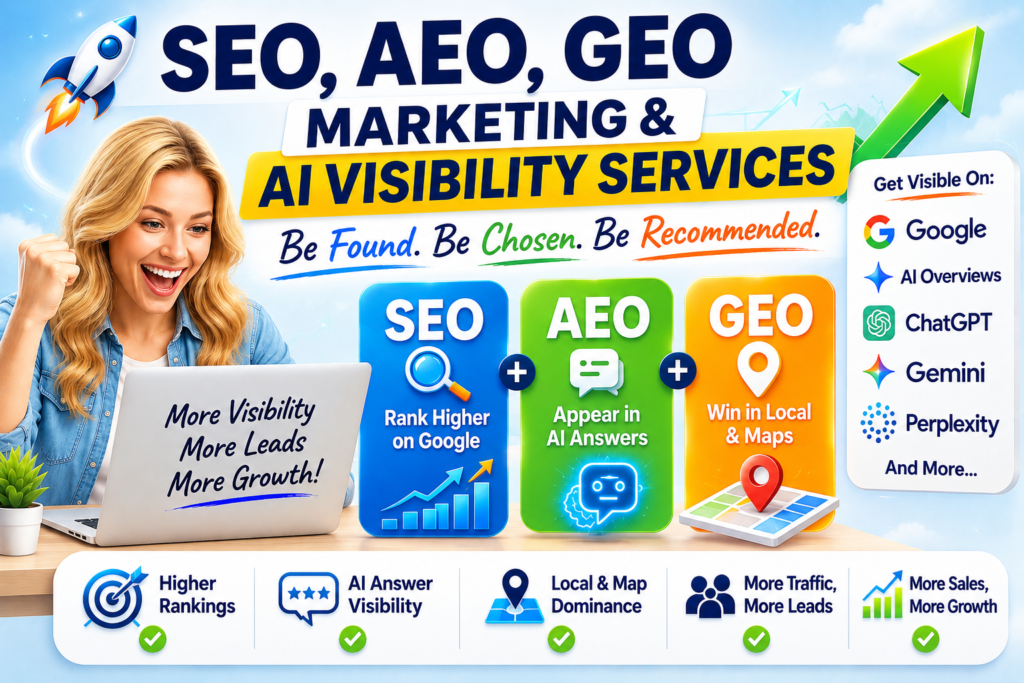
SEO, AEO, GEO marketing helps businesses become easier to find, easier to understand, and easier to recommend across Google, Google Maps, AI Overviews, ChatGPT, Gemini, Perplexity, Claude, and other modern search platforms.
Search has changed. Today, people no longer rely only on short keyword searches. Instead, they ask full questions, use voice search, compare businesses in Google Maps, check reviews, and ask AI tools for recommendations before making decisions.
Because of that shift, your website needs more than basic keywords. It must explain your services clearly, answer customer questions directly, and give search engines enough context to understand why your business is relevant.
Assistant Etc helps businesses strengthen that foundation through search-friendly content, answer-focused structure, AI-readable website messaging, local visibility support, Google Business Profile optimization, semantic content, FAQs, schema-ready content, and stronger digital trust signals.
Get Help With AI VisibilityTL;DR: What Is SEO, AEO, GEO Marketing?
SEO, AEO, GEO marketing is a modern visibility strategy that helps businesses improve traditional search visibility, answer-based visibility, generative AI visibility, and AI-powered discovery.
In simple terms, SEO helps your business get found in search engines. Meanwhile, AEO helps your content answer questions clearly, and GEO helps generative AI tools understand and summarize your business. Together, these strategies make your brand easier to discover across both Google and AI-powered search experiences.
- SEO improves traditional search visibility on Google and other search engines.
- AEO improves answer-based visibility for featured snippets, voice search, FAQs, and conversational search.
- GEO improves how generative AI tools understand, summarize, and connect your business to relevant services.
- AI visibility helps your business become easier to discover in ChatGPT, Gemini, Perplexity, Claude, and Google AI Overviews.
- Local SEO helps your business appear in “near me” searches, Google Maps, and Google Business Profile results.
- Schema markup helps search engines understand the meaning, structure, and entities on your page.
- Helpful, original, trustworthy content is still the foundation of modern visibility.
Why SEO Alone Is No Longer Enough
Traditional SEO still matters, but it is no longer the full picture. For example, a business can have a website and still be invisible in the places where customers now search. People ask longer questions, use AI tools for recommendations, check Google Business Profiles, read reviews, scan AI summaries, and expect fast answers before they click.
Therefore, modern visibility requires more than keywords. Your website needs clear service pages, strong local signals, helpful explanations, structured answers, credible brand information, internal links, schema markup, and content that explains who you help, what you do, where you serve, and why people should trust you.
When a website does not clearly explain its services, search engines and AI tools may struggle to understand the business. In addition, thin, vague, outdated, or copied content makes it harder to earn trust. Local visibility can also suffer when the Google Business Profile is incomplete or disconnected from the website.
For additional context on search-friendly website basics, review Google Search Central’s SEO Starter Guide.
Modern marketing is not just about ranking for keywords. Instead, it is about becoming the clearest, most trustworthy, and most useful answer for the customer’s question.
What Is SEO?
SEO stands for Search Engine Optimization. It is the process of improving your website so search engines can understand your content and users can find your business when they search for your services.
SEO includes on-page content, page titles, headings, internal links, technical structure, mobile usability, crawlability, site speed, local relevance, content quality, and authority signals. In practical terms, it should make your services, audience, locations, and credibility easy to understand.
However, strong SEO does not mean stuffing keywords into a page. Instead, it means building useful pages that answer real search intent. A service page should explain the service, a local page should connect that service to a location, and a blog post should answer a specific question.
As a result, your homepage, service pages, local pages, and blog content should work together. Each page should guide visitors to the next step while also helping Google understand how your services connect to your brand.
SEO Helps With:
- Organic Google visibility.
- Service page rankings.
- Local search visibility.
- Google Maps support.
- Website traffic from search engines.
- Better content organization.
- Improved user experience.
- Clearer website messaging.
- Search engine crawlability.
- Conversion-focused page structure.
What Is AEO?
AEO stands for Answer Engine Optimization. It helps your content answer specific customer questions clearly enough to support featured snippets, voice search, AI answers, FAQ sections, and conversational search results.
AEO matters because people search differently now. Instead of typing only “marketing services,” they may ask, “How do I get my business recommended by ChatGPT?” or “Why is my business not showing up near me?” Therefore, your content needs to match real questions, not just short keywords.
Answer-focused content gives search engines and AI tools clear, direct, extractable information. However, that does not mean every page should sound robotic. The best answer content is natural, specific, helpful, and easy to scan.
For example, a strong AEO section usually starts with a simple definition. After that, it gives supporting details, examples, and context so the answer feels complete rather than thin.
AEO Helps With:
- Featured snippet opportunities.
- Voice search responses.
- FAQ visibility.
- Google AI Overviews readiness.
- Question-based search traffic.
- Clearer content for users.
- Better AI summarization.
- More helpful page structure.
AEO works best when your page includes clear questions, direct answers, helpful explanations, and supporting details that prove the answer is trustworthy.
What Is GEO?
GEO stands for Generative Engine Optimization. It focuses on making your website easier for generative AI systems to understand, summarize, connect to relevant entities, and potentially mention in AI-generated answers.
GEO is about preparing your content for AI-powered discovery. Because AI systems rely on context, they look for clear explanations, trustworthy information, recognizable entities, consistent brand details, helpful answers, and content that can be summarized without confusion.
For a business, this means the website should clearly explain the services, locations, brand name, audience, process, proof points, FAQs, and unique value. In contrast, vague claims, thin pages, missing service descriptions, and generic wording make the business harder to understand.
Additionally, GEO works best when your content connects related ideas. For instance, a page about SEO, AEO, GEO marketing should also mention AI visibility, local SEO, Google Business Profile support, schema markup, answer engines, and customer search behavior.
GEO Helps With:
- AI search visibility.
- Brand understanding by AI tools.
- Entity recognition.
- AI answer inclusion opportunities.
- Topical authority building.
- Better content summarization.
- Clearer service descriptions.
- More consistent digital presence.
SEO vs AEO vs GEO vs AI Visibility
SEO, AEO, GEO, and AI visibility work together. Although each strategy has a different purpose, they should not be treated as separate trends. SEO builds the search foundation, while AEO improves answer clarity. Then, GEO prepares content for generative AI systems. As a result, AI visibility connects all of these strategies so your business is easier to discover across modern search platforms.
| Marketing Type | Main Goal | Best For | What It Requires |
|---|---|---|---|
| SEO | Help search engines find, crawl, understand, and rank your website. | Google rankings, organic traffic, service pages, blogs, and local search. | Optimized titles, headings, content, internal links, schema, technical structure, and helpful pages. |
| AEO | Answer specific user questions clearly and directly. | Featured snippets, FAQs, voice search, AI-style answers, and question-based searches. | Direct answers, question headings, FAQ sections, plain-language explanations, and structured content. |
| GEO | Help generative AI tools understand and summarize your business. | ChatGPT, Gemini, Perplexity, Claude, Google AI Overviews, and AI search experiences. | Entity-rich content, clear service descriptions, topical depth, schema, credibility signals, and consistent brand information. |
| AI Visibility | Improve your chances of being discovered, understood, mentioned, or recommended by AI-powered platforms. | Businesses that want to compete in modern search, AI answers, local recommendations, and conversational discovery. | SEO, AEO, GEO, local SEO, Google Business Profile optimization, reviews, content quality, and technical accessibility. |
Is Your Business Showing Up in AI Answers?
Ask ChatGPT, Gemini, Perplexity, or Google AI-style search questions about your industry and location. If your competitors appear and you do not, your website may need stronger AI visibility optimization.
Request AI Visibility HelpWhat Is AI Visibility?
AI visibility means your business is easy for AI search tools, answer engines, and generative platforms to understand, associate with relevant services, and consider when users ask related questions.
AI visibility is not a guaranteed ranking system. No ethical provider can promise that ChatGPT, Gemini, Perplexity, Claude, or Google AI Overviews will recommend a specific business. However, a business can improve the signals that make its website easier to crawl, understand, summarize, and trust.
Those signals include clear website structure, detailed service pages, accurate business information, helpful FAQs, location signals, Google Business Profile optimization, reviews, internal links, external mentions, schema markup, and content that answers real customer questions.
In other words, AI visibility is built from clarity, consistency, and authority. When your website explains the right information in the right structure, both people and platforms can understand your business faster.
AI Visibility Questions Businesses Should Ask
- Can AI tools clearly understand what my business does?
- Does my website explain who I help and where I serve customers?
- Do my pages answer common customer questions directly?
- Does my Google Business Profile support my website content?
- Are my services described in enough detail?
- Is my business information consistent across the web?
- Do I have content that proves topical authority?
- Can search engines and AI crawlers access my important pages?
How Customers Search Now
Customers are using more than one search path. For instance, one person may search Google, while another may ask ChatGPT for recommendations. Meanwhile, someone else may search Google Maps, use voice search while driving, or compare businesses based on reviews, website content, and AI summaries.
Consequently, your business needs to be visible in several places, not just one. A modern visibility strategy should connect your website, content, Google Business Profile, local pages, service pages, blog posts, reviews, FAQs, schema, and brand messaging.
Because people move between platforms quickly, consistency matters. The same business name, service details, location context, and value proposition should appear across your website, Google profile, directory listings, and content.
Examples of Modern Search Queries
- “Best marketing company near me.”
- “Who helps small businesses get found on Google?”
- “How do I get my business recommended by ChatGPT?”
- “What is AI visibility marketing?”
- “SEO vs AEO vs GEO explained.”
- “Best local business for [service] near me.”
- “How can I make my website show up in AI Overviews?”
- “Why is my competitor showing up on Google Maps and I am not?”
If your content does not answer the way people search now, your business may be missing traffic, leads, calls, clicks, and AI recommendation opportunities.
What an SEO, AEO, GEO Marketing Strategy Should Include
A strong SEO, AEO, GEO marketing strategy should improve both visibility and clarity. The goal is not only to attract visitors. Instead, the goal is to help the right people understand your value quickly and take action.
To do that, your strategy should connect technical SEO, useful content, direct answers, local visibility, and conversion-focused messaging. Additionally, each part should support the others so your website feels organized instead of scattered.
SEO Foundation
Keyword strategy, page structure, service pages, metadata, internal links, technical cleanup, crawlability, and search-friendly content.
AEO Content Structure
Question-based headings, direct answer boxes, FAQ sections, voice-search-friendly answers, and featured snippet formatting.
GEO Optimization
Entity-rich content, clear brand context, service relationships, topical depth, schema markup, and AI-readable summaries.
Local Visibility
Google Business Profile optimization, local service pages, city relevance, reviews, map visibility, and “near me” search support.
Content Authority
Helpful blogs, service explanations, comparison pages, how-to content, FAQs, case-style examples, and educational resources.
Conversion Optimization
Clear calls to action, trust signals, scannable sections, stronger page flow, service clarity, and next-step buttons.
SEO, AEO, GEO Marketing Checklist
Use this checklist to review whether your website is prepared for modern search and AI visibility. While every business is different, these items provide a practical starting point for improving clarity, structure, and discoverability.
- Your homepage clearly explains what your business does within the first few seconds.
- Each main service has its own optimized service page.
- Your pages include clear H1, H2, and H3 headings.
- Your content answers real customer questions.
- Your website includes FAQ sections where helpful.
- Your pages use internal links to connect related services and topics.
- Your title tags and meta descriptions are unique.
- Your Google Business Profile is complete, accurate, and active.
- Your business name, address, phone number, website, and service details are consistent.
- Your site includes schema markup where appropriate.
- Your content is original, helpful, and not copied from competitors.
- Your pages explain who you help, what you offer, and where you serve.
- Your content includes direct answers for AI and voice search extraction.
- Your website is mobile-friendly and easy to scan.
- Your business has clear calls to action.
- Your content demonstrates trust, experience, and practical expertise.
Frequently Asked Questions About SEO, AEO, GEO Marketing
What does SEO, AEO, GEO marketing mean?
SEO, AEO, GEO marketing means optimizing your website for search engines, answer engines, generative AI platforms, and AI-powered search experiences. As a result, your business becomes easier to find, understand, summarize, and recommend online.
What is the difference between SEO and AEO?
While SEO focuses on helping websites appear in search engines, AEO focuses on answering user questions clearly. Consequently, AEO can support featured snippets, voice search, FAQs, and AI-style answers.
What is the difference between GEO and SEO?
Although SEO focuses on traditional search visibility, GEO focuses on generative AI visibility. Specifically, GEO makes content easier for AI tools to understand, summarize, connect to entities, and use in AI-generated responses.
Can SEO help my business show up in AI tools?
Yes, SEO can support AI visibility because crawlable, helpful, well-structured content is easier for search systems and AI tools to understand. However, AI visibility also requires clear answers, entity-rich content, trust signals, and strong topical structure.
Can you guarantee my business will be recommended by ChatGPT?
No. No ethical provider can guarantee that ChatGPT, Gemini, Claude, Perplexity, or Google AI Overviews will recommend a specific business. Instead, the goal is to improve quality, clarity, accessibility, and trust signals that may increase visibility opportunities.
Why does my competitor show up in AI answers but I do not?
In many cases, competitors appear more often because they have stronger online authority, clearer service pages, more reviews, better local signals, stronger content, better schema, more mentions, or more complete business information. Therefore, an AI visibility audit can help identify the most important gaps.
Does Google Business Profile help with AI visibility?
Yes. A complete and active Google Business Profile can support local visibility, map visibility, business trust, and search relevance. For the best results, it should work together with your website content, reviews, services, and local pages.
What type of content is best for AI visibility?
The best content for AI visibility is clear, specific, helpful, original, well-structured, and easy to summarize. In addition, strong pages include direct answers, FAQs, service details, local context, examples, internal links, and trust-building information.
Is schema markup required for SEO, AEO, and GEO?
Schema markup is not the only ranking factor, but it helps search engines better understand page content, entities, services, FAQs, breadcrumbs, articles, and business information. For that reason, it can support SEO, AEO, GEO, and AI readability.
How do I know if my business needs AI visibility optimization?
You may need AI visibility optimization if your business does not appear when people ask AI tools about your services, industry, or location. This is especially important when competitors are being mentioned instead.
Summary: SEO, AEO, GEO Marketing Helps Your Business Compete in Modern Search
SEO, AEO, GEO marketing makes your business easier to find, easier to understand, and easier to trust across the platforms people now use to make decisions. Traditional search still matters; however, modern visibility also includes AI answers, Google AI Overviews, voice search, Google Maps, local discovery, and conversational search tools.
Assistant Etc helps businesses improve their online presence with clearer website content, stronger service pages, better FAQs, Google Business Profile support, local visibility content, AI-friendly structure, and practical recommendations designed for today’s search environment.
Therefore, if your business is not showing up when people search for your services or ask AI tools who to hire, it may be time to improve your SEO, AEO, GEO, and AI visibility strategy.
Ready to Improve Your Online Visibility?
Let’s make your website clearer, stronger, more helpful, and easier for Google and AI tools to understand.
Start HereDisclaimer: SEO, AEO, GEO, and AI visibility strategies can improve your online visibility foundation, but no provider can ethically guarantee specific rankings, AI mentions, traffic, leads, customers, or revenue.