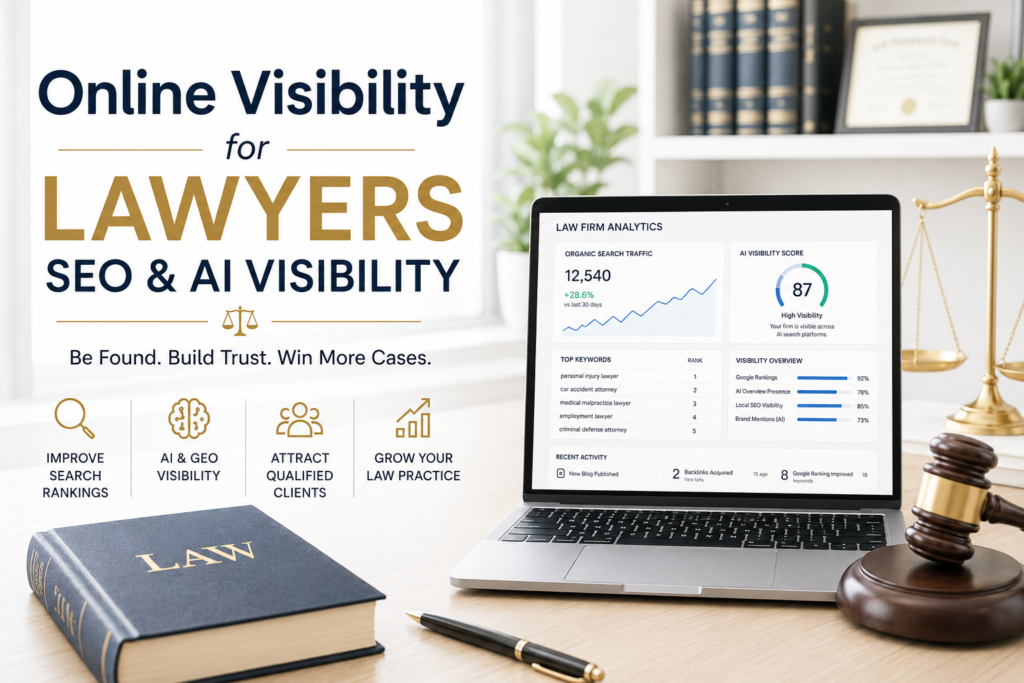
Online Visibility for Lawyers – SEO & AI Visibility
Online visibility for lawyers helps law firms become easier to find when potential clients search Google, Google Maps, Google AI Overviews, ChatGPT, Perplexity, Gemini, voice search, and other modern search tools for legal help.
Legal search is different from ordinary business search. A person looking for an attorney is often under pressure. They may be dealing with an injury, a divorce, a criminal charge, an immigration concern, a business dispute, an estate issue, or a deadline they do not fully understand.
That person is not casually browsing. They are trying to reduce risk. They want to know who is credible, who handles their type of matter, who is close enough to help, who has strong reviews, and who appears trustworthy before they make contact.
This is why a law firm’s online presence must do more than exist. Your website, practice area pages, attorney bios, Google Business Profile, reviews, local citations, educational content, and schema markup must work together to explain what your firm does, who you help, where you serve clients, and why your firm can be trusted.
Modern law firm visibility is not only about ranking for “lawyer near me.” It is about building enough digital clarity and authority so search engines, AI-powered answer systems, and potential clients can quickly understand your firm.
Contact Us for a FREE Website Audit or for QuestionsWhy Legal Clients Search Differently Than Regular Customers
Most legal clients are not searching from a calm, neutral place. They are often worried about time, money, consequences, reputation, custody, medical bills, court dates, contracts, immigration status, criminal records, property, or family stability.
That emotional pressure changes how they search. A potential client may start with a broad search like “divorce lawyer near me,” then quickly move into more specific questions such as “What happens if my spouse already filed?” or “Can I protect my house during divorce?”
A personal injury lead may search “car accident lawyer near me,” but they may also ask, “Should I talk to the insurance company first?” or “How long do I have to file a claim?” A criminal defense lead may search urgently at night after an arrest. An estate planning client may compare attorneys more slowly, looking for signs of trust, experience, and professionalism.
Strong legal visibility is built around client intent, not just keywords. The page must match the urgency, fear, questions, and decision process behind the search.
The Problem With Thin Law Firm Websites
Many law firm websites look professional on the surface but fail to explain enough. They may have a homepage, a contact page, a short attorney bio, and a few basic practice area pages. That is usually not enough for competitive search.
Search engines need detail. AI-powered search tools need context. Potential clients need reassurance. If your website does not clearly explain your legal services, local presence, attorney authority, client process, and practice area knowledge, another law firm may appear more credible online.
Thin pages also create a trust gap. A page that only says “we handle divorce cases” gives a search system and a potential client very little to work with. A stronger page explains contested divorce, uncontested divorce, custody concerns, property issues, support questions, consultation steps, local court relevance, and when someone should speak with an attorney.
The same applies to personal injury, estate planning, criminal defense, immigration, bankruptcy, workers’ compensation, business law, employment law, real estate law, and other legal practice areas.
What Online Visibility for Lawyers Actually Includes
Online visibility for lawyers is the full system that helps your firm appear credible across search results, local map results, AI-generated answers, review platforms, legal directories, and attorney-related searches.
For a law firm, this usually includes:
- Clear practice area pages that explain your legal services in detail.
- Attorney bio pages that show experience, credentials, bar admissions, and trust signals.
- Google Business Profile optimization for legal categories, location signals, photos, reviews, and updates.
- Local SEO content that connects your firm to the cities, counties, courts, and communities you serve.
- FAQ sections that answer legal-intent questions without overpromising results.
- Schema markup that gives search systems structured information about your firm and pages.
- Internal linking that connects related legal topics naturally.
- Review strategy that reinforces reputation, communication, responsiveness, and client trust.
When these pieces are weak or disconnected, your law firm may appear less clear online. When they are strong, your firm becomes easier to understand, compare, and consider.
Law Firm SEO: The Foundation of Being Found
Law firm SEO helps search engines understand your website and connect your firm with people searching for legal help. It is still the foundation of digital visibility because Google and other search systems rely on crawlable pages, relevant content, internal links, structured information, and trust signals.
For lawyers, SEO must be more precise than generic marketing SEO. The page should identify the legal service, client problem, geographic relevance, attorney credibility, and next step. A page about estate planning should not read like a page about criminal defense. A personal injury page should not be vague enough to apply to every practice area.
Strong law firm SEO often includes dedicated pages for each important practice area. For example, a personal injury firm may need separate pages for car accidents, truck accidents, motorcycle accidents, slip and falls, wrongful death, pedestrian injuries, and insurance disputes. A family law firm may need pages for divorce, child custody, child support, spousal support, property division, mediation, and post-decree modifications.
Each page should answer the questions a real client would ask before calling. This helps users, search engines, and AI-powered search tools understand the page more clearly.
AEO for Lawyers: Answering Legal Questions Clearly
AEO stands for Answer Engine Optimization. For attorneys, AEO means structuring legal content so it can answer common questions directly while still encouraging readers to contact a qualified lawyer for advice about their specific situation.
This matters because legal searches are often question-based. People ask things like “Do I need a lawyer after a car accident?” “Can I file for divorce without my spouse agreeing?” “What happens after a DUI arrest?” “How do I avoid probate?” or “What should I bring to a consultation?”
A strong legal answer should be clear, useful, and careful. It should not promise a result. It should not give overly broad legal advice. It should explain the issue in plain language, identify factors that may matter, and guide the reader toward the next responsible step.
This style of content can help law firms appear more helpful and trustworthy. It also makes the page easier to extract, summarize, and reference in modern search experiences.
GEO for Law Firms: Helping Generative Search Understand Your Firm
GEO stands for Generative Engine Optimization. For law firms, GEO focuses on making your online presence understandable to systems that generate answers, compare options, summarize businesses, and respond to conversational prompts.
Generative search tools may look for consistency across multiple sources. They may evaluate your website, attorney profiles, reviews, legal directories, Google Business Profile, local listings, structured data, and topic coverage. If those signals do not match, your firm can appear unclear.
For example, if your website highlights family law, but your Google Business Profile categories, reviews, and local content barely mention divorce or custody, your legal entity signals are weaker. If your attorney bio lacks detail, your practice area pages are thin, and your reviews do not reinforce your key services, your firm may be harder to interpret.
GEO is not about tricking AI tools. It is about making your law firm’s public information consistent, specific, and useful enough to be understood accurately.
Is Your Law Firm Clear Enough Online?
If your website does not clearly explain your practice areas, local relevance, attorney authority, and client process, potential clients may trust a competing firm first.
Contact Us for a FREE Website Audit or for QuestionsWhy Client Intake Psychology Matters in Legal Marketing
Legal marketing is not only about traffic. It is about trust at the exact moment a person is deciding whether to contact a lawyer.
A potential client usually has unspoken questions. Can this attorney handle my type of case? Will I be judged? Will I understand the fees? Will someone call me back? Is this firm local? Do they deal with situations like mine? Will contacting them make things clearer or more stressful?
Your website should lower that uncertainty. This can be done through clear practice area explanations, simple consultation instructions, strong attorney bios, helpful FAQs, review signals, contact options, office location details, and content that explains what happens next.
When a law firm page only talks about being “aggressive,” “experienced,” or “dedicated,” it may miss the deeper issue. Clients want confidence before they reach out. Strong content helps them feel oriented before they make the call.
Local Legal Urgency and “Near Me” Search Behavior
Local search matters heavily for law firms because legal needs are often tied to location. Courts, county procedures, local filing rules, judges, police departments, accident locations, real estate, businesses, and family matters can all have geographic relevance.
A person searching for a lawyer may not only want any attorney. They may want someone near the courthouse, someone who handles cases in their county, someone who understands local procedures, or someone close enough for an in-person consultation.
This is why local legal visibility should include more than a city name on the homepage. Strong local SEO may involve city pages, county references, local practice area pages, Google Business Profile optimization, consistent citations, local reviews, office information, and content that explains how your firm serves nearby communities.
For urgent legal matters, clarity matters even more. Someone facing an arrest, injury, protective order, emergency custody issue, eviction concern, immigration deadline, or business dispute may contact the first credible firm that appears trustworthy and easy to reach.
Why Google Business Profile Is Critical for Attorneys
Your Google Business Profile is one of the most visible local assets your law firm has. It can influence how your firm appears in Google Maps, local search results, branded searches, and nearby attorney searches.
For law firms, the profile should be accurate, active, and aligned with your website. Your business name, address, phone number, legal categories, service areas, office hours, photos, reviews, and website link should all support the same message.
A neglected profile may weaken trust. Missing categories, outdated hours, few reviews, weak descriptions, poor photos, and inconsistent information can make a firm look less active. A stronger profile gives potential clients more confidence before they click or call.
Google Business Profile optimization is especially important for searches such as “lawyer near me,” “divorce attorney near me,” “criminal defense lawyer near me,” “personal injury attorney near me,” and other local legal queries.
Attorney Bios Are Not Optional Trust Pages
Attorney biography pages are often underused. Many firms treat them as short resumes, but they can become powerful trust-building assets when written correctly.
A strong attorney bio should help users and search systems understand who the attorney is, what they handle, where they are licensed, what experience they bring, what professional background they have, and why a potential client may feel comfortable contacting them.
For legal visibility, attorney bios may support E-E-A-T by showing real credentials, legal experience, speaking or publishing history, bar admissions, education, awards, professional memberships, representative case types, and client-centered service philosophy.
Attorney bios also help connect a person to a legal entity. A law firm with detailed attorney pages usually sends stronger trust signals than a site with anonymous or thin content.
Reviews and Reputation Signals for Law Firms
Reviews matter because clients want proof that other people trusted the firm before them. In legal marketing, reviews can communicate responsiveness, professionalism, communication, compassion, preparation, and confidence.
Review language can also reinforce practice area relevance. For example, reviews may mention divorce, custody, car accidents, probate, immigration filings, criminal charges, contracts, real estate closings, workers’ compensation, or business disputes.
When reviews repeatedly mention specific legal services, the firm’s online identity becomes clearer. That does not mean a law firm should manipulate reviews. It means the firm should ethically encourage satisfied clients to describe their real experience in their own words.
Reputation signals become stronger when your reviews, website, Google Business Profile, attorney bios, and legal directories all tell a consistent story about the work your firm handles.
Schema Markup for Lawyer Websites
Schema markup gives search engines structured information about your law firm and website pages. It does not replace strong content, but it can help clarify what each page represents.
For lawyer websites, useful schema may include Organization, LegalService, LocalBusiness, Service, WebPage, BreadcrumbList, FAQPage, and Person schema for attorney bios. Practice area pages may also benefit from service-focused structured data when implemented correctly.
Schema can help clarify your firm name, website URL, service type, audience, page topic, FAQ content, and relationship between the page and your organization.
Schema does not guarantee rankings or AI mentions. Its value is clarity. When paired with original content and strong legal entity signals, schema can support better machine readability.
Legal Entity Optimization: Making the Firm Easier to Understand
Entity optimization helps search systems understand your law firm as a real organization connected to attorneys, practice areas, locations, legal topics, and trust signals.
A law firm entity may connect to many related concepts: attorney names, legal services, bar admissions, cities served, counties served, client reviews, office locations, practice areas, publications, local directories, and professional profiles.
The goal is consistency. If your firm handles estate planning, that topic should appear clearly on your website, relevant service pages, attorney bios, Google Business Profile, reviews, and directory profiles. If you handle criminal defense, your public signals should support that as well.
When these signals are scattered or inconsistent, your firm may be harder to classify. When they are aligned, your legal brand becomes more understandable across search systems.
Why Practice Area Pages Need More Than Keywords
Many law firm pages fail because they repeat keywords without answering the client’s actual concerns. A strong practice area page should explain the problem, the legal context, the possible stakes, the attorney’s role, and what the client can do next.
For example, a criminal defense page should discuss the seriousness of charges, court process concerns, defense strategy questions, consultation urgency, and why early legal guidance may matter. A divorce page should address uncertainty around children, property, support, timing, and communication. An estate planning page should explain wills, trusts, powers of attorney, probate concerns, and family protection.
The best legal content feels specific. It should not read like a generic page that could belong to any law firm in any state.
Originality matters because clients can recognize thin content quickly. Search systems can also compare pages across the web and identify content that adds little new value.
Internal Linking for Legal Websites
Internal linking helps users and search engines understand the relationship between your pages. For law firms, internal links should guide visitors from broad topics to specific services and from educational content to consultation-focused pages.
For example, a blog post about what to do after a car accident can link to your car accident lawyer page, personal injury page, insurance claim page, and consultation page. A divorce FAQ can link to pages about child custody, property division, spousal support, and mediation.
This structure supports topical authority. It also improves the user journey. A visitor should never feel stuck after reading a helpful answer. The next step should be obvious.
Search Everywhere Optimization for Attorneys
Potential clients may discover a lawyer in more than one place. They may search on Google, view Maps results, check reviews, visit legal directories, watch a video, read a blog post, see a Facebook page, visit LinkedIn, or ask an AI search tool for options.
This means law firms should not rely on one visibility channel. A consistent presence across several trusted platforms can support stronger recognition and credibility.
Search Everywhere Optimization for attorneys means your firm’s information should be accurate and consistent wherever potential clients may encounter it. Your name, phone number, office location, practice areas, attorney details, and service descriptions should not conflict across platforms.
Consistency helps people trust you. It also helps search systems understand your firm with less confusion.
Want a Stronger Legal Visibility Foundation?
Your law firm may be missing visibility opportunities if your practice area pages, attorney bios, Google Business Profile, reviews, schema, and local signals are not working together.
A website audit can identify what is unclear, thin, outdated, duplicated, or difficult for search systems to interpret.
Contact Us for a FREE Website Audit or for QuestionsOur Online Visibility Services for Lawyers
Our online visibility services for lawyers are built to help law firms become easier to find, evaluate, and contact online. The goal is not just more traffic. The goal is better visibility with the right legal audience.
Depending on your firm’s current online presence, services may include law firm SEO audits, AI visibility audits, practice area page optimization, Google Business Profile improvement, local SEO strategy, FAQ development, schema markup, attorney bio enhancement, internal linking, content planning, and website structure recommendations.
We also review whether your site clearly communicates legal authority, location relevance, service focus, client trust, and next-step clarity. These are critical for law firms because potential clients often decide quickly whether they feel confident enough to call.
The end goal is a stronger digital foundation that helps your law firm appear more understandable, credible, and relevant across traditional search and modern AI-assisted discovery.
Frequently Asked Questions About Online Visibility for Lawyers
Why does online visibility matter for a law firm?
Online visibility matters because many potential clients research attorneys before calling. They compare practice areas, reviews, location, attorney bios, website quality, and trust signals before deciding which firm to contact.
What makes law firm SEO different from regular SEO?
Law firm SEO must account for legal intent, local relevance, attorney credibility, practice area specificity, client urgency, ethical communication, and trust. A legal website cannot rely on generic service-page wording alone.
Do attorneys need separate pages for every practice area?
In most cases, yes. Separate practice area pages help explain each legal service more clearly. They also help users and search systems understand whether your firm handles the specific problem someone is searching for.
Why are attorney bios important for visibility?
Attorney bios help show real experience, credentials, bar admissions, education, professional background, and trust signals. They also help connect legal services to actual attorneys within the firm.
Can AI search tools mention or compare law firms?
AI search tools may summarize publicly available information about law firms, attorneys, reviews, services, locations, and online reputation. Stronger public information can make a firm easier to understand, but no ethical marketer can guarantee AI recommendations.
How does Google Business Profile help lawyers?
Google Business Profile supports local visibility by displaying firm information, reviews, categories, photos, office details, and contact options. It is especially important for searches involving nearby attorneys or local legal services.
What role do reviews play in legal marketing?
Reviews help potential clients evaluate trust, responsiveness, professionalism, and client experience. Review language can also reinforce the types of legal matters your firm handles.
Is FAQ content useful for lawyers?
Yes. FAQ content helps answer common legal-intent questions in a clear and careful way. It can improve user experience and help search systems understand what legal topics your firm covers.
Does schema markup guarantee better rankings for law firms?
No. Schema markup does not guarantee rankings. It helps search systems better understand the structure and meaning of your content when used alongside strong website content, clear pages, and credible firm information.
Can a law firm rank on Google but still be weak in AI visibility?
Yes. A firm may rank for some traditional searches while still lacking the structured explanations, entity consistency, review depth, attorney authority signals, and answer-ready content needed for stronger AI-assisted visibility.
What types of law firms benefit from SEO, AEO, GEO, and AI visibility?
Personal injury firms, family law firms, divorce attorneys, criminal defense lawyers, estate planning attorneys, immigration lawyers, bankruptcy lawyers, business attorneys, employment lawyers, real estate attorneys, and multi-location firms can all benefit from stronger online visibility.
Can you guarantee that Google or ChatGPT will recommend my law firm?
No. No one can ethically guarantee recommendations from Google, ChatGPT, Perplexity, Gemini, or other AI-powered systems. What can be improved are the public signals that help those systems understand your firm more clearly.
Ready to See What May Be Holding Your Law Firm Back?
A legal visibility review can show whether your website, Google Business Profile, reviews, practice area pages, attorney bios, schema, and local content are helping or weakening your online presence.
Contact Us for a FREE Website Audit or for QuestionsFinal Thoughts
Law firm visibility is becoming more complex. Potential clients still use Google, but they also rely on Maps, reviews, legal directories, voice search, AI-generated summaries, and conversational search tools.
The firms that stand out are usually the firms with clear practice area pages, strong attorney bios, consistent local signals, helpful educational content, accurate structured data, trustworthy reviews, and a website that explains the client’s next step.
Legal marketing should never depend on generic content or copied service descriptions. A law firm needs original, specific, client-centered content that reflects the way people actually search when legal pressure is real.
Ultimately, stronger online visibility helps your firm become easier to find, easier to understand, and easier to trust when a potential client is ready to take action.